
189TH ASAULT HELICOPTER COMPANY
HISTORY
PREFACE
The history of the 189th Assault Helicopter Company for the years
1966 Through 1971 has been written
so that the officers and enlisted men of the 189th can be recognized
for their outstanding work, esprit de corps, and dedication to their country
during their tour of duty in the Republic of Vietnam.
PURPOSE
The purpose of this history is to outline the events that occurred in the 189th
Assault Helicopter Company during the calendar years 1966 through 1971.
It is intended to give as accurate and factual account as possible of the
fine officers and enlisted men, its equipment, as well as a concise picture of
the combat operations in-which the unit participated.
Many accounts were researched through the National Archives, Texas State
University, the VHPA, and information collected from members of the unit. This
history in not complete, it is a work in progress, but it as accurate as can be
from the information gathered. The
more feedback we get the more accurate the history.
This history is a collection of actions that took place in the 189th
Assault Helicopter Company both on and off the battlefield.
COMMAND AND CONTROL
The unit history would be incomplete if the officers and men of the 189th
Assault Helicopter Company failed to pay tribute to their commanders who played
the major role in developing and maintaining the unit's high standard of
professionalism, esprit de corps and noted combat effectiveness.
through their professional competence, thorough knowledge, exceptional
leadership and loyalty to their men, they succeeded in building a foundation
that formed one of the finest fighting units in the Republic of Vietnam and in
the United States Army.
Even today the men of the 189th Assault Helicopter Company would like
to express their appreciation for their outstanding leadership, personal concern
and invaluable guidance they provided while serving as Company Commanders.
The following were Company Commanders of the GHOSTRIDERS and AVENGERS
Captain Victor Hamilton
1 Nov 66 - 1 Dec 66
Major Robert T Bagley
1 Dec 66 - 21 Dec 66
Major John J Webster
21 Dec 66 - 1 Jul 67
Major Bobby L Sanders
1 Jul 67 - 2 Jan 68
Major Neil I Leva
2 Jan 68 - 15 Apr 68
Major William W Fraker 15 Apr 68 - 3 Oct 68
Major Robert N Morrison
3 Oct 68 - 22 Apr 69
Major Richard L Lincoln
22 Apr 69 - 28 Sep 69
Major John P Ratliff 28 Sep 69 - 6 Mar 70
Major George A Morgan
6 Mar 70 - 11 Nov 70
Respectfully
Brothers Forever
The GHOSTRIDERS and AVENGERS
Organization of the 189th AHC
Constituted 23 September 1942 in the Army of the United States as the 2027th
Quartermaster Truck Company, Aviation.
Activated 5 October 1942 at Lockbourne Army Air Base, Ohio.
Inactivated 20 February 1946 in the Philippine Islands.
Converted and re-designated 1 August 1946 as the 2027th
Transportation Company (Aviation).
Re-designated 1 November 1966 as the 189th Aviation Company, allotted
to the Regular Army, and activated at Fort Carson, Colorado.
Entered the Vietnam Conflict May 1967 and assigned to the 52d Combat Aviation
Battalion at Camp Holloway, Pleiku, Vietnam.
The 189th was just one (1) unit of the largest Aviation Battalions
ever formed; the 52nd Combat Aviation Battalion (CAB)
The Flying Dragons was subordinate to
the 17th Combat Aviation Group (CAG). The 17th CAG was
subordinate to the 1st Aviation Brigade, the largest Army Aviation
organization formed since World War II. The 1st Aviation Brigade was
comprised of several Groups, each having several Battalions.
Inactivated 15 March 1971 in Vietnam.
Assigned 19 February 1986 to the 3d Armored Division and activated in Germany.
Inactivated 16 July 1987 in Germany.
189th Campaign Participation Credit
World War AP
New Guinea
Leyte
Vietnam
Counteroffensive, Phase II
Counteroffensive, Phase III
Tet Counteroffensive
Counteroffensive, Phase IV
Counteroffensive, Phase V
Counteroffensive, Phase VI
Tet 69/Counteroffensive
Summer-Fall 1969
Winter-Spring 1970
Sanctuary Counteroffensive
Counteroffensive, Phase VII
Philippine Presidential Unit Citation, Streamer embroidered 17 October 1944 to 4
July 1945.
Republic of Vietnam Cross of Gallantry with Palm, Streamer embroidered Vietnam
1967-1968.
Presidential Unit Citation, October 29, 1967 to 30 November 1967. DA GO 38 Dated
20 July 1971
Republic of Vietnam Civil Action Honor Medal, First Class, Streamer embroidered
Vietnam 1970
The 189th Aviation Company History
1966 - 1967
1966
The 189th Aviation Company (AML) was activated by Department of the
Army with Fifth Army General Order 236, dated 19 September 1966, to take effect
on 1 November 1966 at Fort Carson, Colorado. Shortly before Thanksgiving, the
U.S. Army began assembling a group of aviators at Ft. Carson, Colorado. The
mountainous area around Ft. Carson, it was hoped, would give the aviators a
certain degree of training in mountain flying before being deployed to its
ultimate destination, the Central Highlands, Republic of Vietnam.
1 November 1966: Captain Victor Hamilton, Infantry, commanded and organized the
unit under TO&E 1-77E (Modified). Under his command, the unit was open for the
receipt of incoming personnel and equipment.
1 December 1966: Major Robert Bagley assumed command. Under his guidance,
request for additional equipment was submitted. A training program was
established, the airfield operations elements were established, and unit
training began.
9 December 1966: The 189th was reorganized under TO&E 1-77G
(Modified) as directed by General Order 427, Fifth Infantry Division and Fort
Carson, Colorado. Under the new TO&E, the 189th was authorized a
Company Headquarters, two (2) Airlift Platoons, a Gun Platoon and a Service
Platoon. The 604th Maintenance Detachment, the 519th
Medical Detachment and the 6th Signal Detachment provided the unit
additional support. Under TO&E 1-77G, the 189th was to prepare for
deployment on a date yet undisclosed. Being one of the first Army units to
receive the new UH-IH Huey, the area was also ideal for testing the new H Model
at mountainous elevations. Sister companies, the 187th & 188th
were also forming and receiving H models at Ft. Campbell, Kentucky during the
same time period. All new aircraft were picked up from the factory in Ft. Worth,
Texas and ferried to Fort Carson, CO.
12 December 1966: The 189th began its formal training. The first week
dealt primarily with basic required subjects such as Code of Conduct, Geneva
Convention, etc. The next few months or so were spent doing supply actions since
the unit was to deploy with full organic equipment. Each day began with physical
training capped with an increasingly longer run around post. When the morning
Colorado temperature dropped below 28 degrees Fahrenheit, physical training was
suspended.
17 December 1966: The Christmas Holidays began, and all formal training ceased
for two weeks.
The initial pilots of the 189th were an odd lot with seven fixed- &
rotary- wing rated Majors assigned to the unit. Many of the Majors in the unit
were primarily old fixed-wing drivers and were not particularly overjoyed with
the idea of going to Vietnam with a helicopter outfit. The remaining aviators,
both lieutenants and warrant officers, were fresh out of flight school. While
lacking maturity and flight experience, they were an enthusiastic and gung-ho
group. Only three personnel, two (2) Warrant Officers and a crew chief had seen
prior service in Vietnam.
21 December 1966: Major John J. Webster, TC assumed command of the Company.
During the remainder of 1966, the unit was primarily involved with aircraft
checkouts required for aviators in the UH-IC and UH-IH
After the Christmas holidays, training became serious under ATP 1-77G and
continued until April 1967.
1967
1 January 1967: The following personnel filled the key positions within the
Company:
Commanding Officer:
Major John Webster
Executive Officer:
Major Robert T. Bagley
First Sergeant:
1SGT Kelly Alfred
Operations Officer:
Major Richard V. Coulter
Intelligence Officer:
Major Jesse E. Stewart
First Airlift Platoon Leader:
Captain Jack W. Blien
Second Airlift Platoon Leader: Major Albert H.
Kraph
Gun Platoon Leader:
Captain Pinckney C. Cochran
Service Platoon Leader:
Captain Wilbur R. Mixer
The associated detachments and their initial commanders were:
604th Maintenance Detachment: Major Richard D. Caldwell
519th Medical Detachment:
WOI Daniel J. Bainey
6th Signal Detachment:
2d Lt. James R. Conley
3 January 1967: Scheduled training resumed and, in preparation for deployment,
the unit began a series of field exercises the first week of 1967. Although the
snow and ice posed many problems, the improved engines in the UH-IH performed
magnificently. As part of the exercise, the gun platoon was conducting its
weapons training and learning about the ways of war and survival. The first week
of the New Year was devoted to basic required subjects.
11 January 1967: Formal flight training began at section and platoon levels
encompassing such subjects as Navigation, Instrument Proficiency, Night and
Formation Flying, Flying with Loads, Gunship Tactics and Air mobile Operations.
20 January 1967: The first company-sized Air Mobile Operation was conducted and
three (3) more followed prior to the Field Training Exercise (FTX) portion of
unit training.
31 January 1967 - 6 February 1967: During this time, the gun platoon conducted
its weapons training, gunnery trained in 7.62 systems and all gunnery personnel
were qualified in the XM-21 and XM-23 systems.
7-9 February 1967: The unit was in the field for the first time where emphasis
on operation of a tactical landing area, security of the area, operational
reaction time, resupply, medical evacuation, and section and platoon-sized Air
Mobile Operations with armed escort took place.
14-16 February 1967: During these field operations, further emphasis was placed
on last week's operation; however, reducing mission reaction time was stressed.
20 February 1967: The 189th was in the field for a five-(5) day
exercise and provided aviation support to the 2/llth Infantry in its Advanced
Infantry Training (AIT) cycle with emphasis on platoon and company-sized
operations, resupply, medical evacuation and a night move all in preparation for
the forthcoming Army Training Test (ATT) cycle. The unit was observed throughout
the operation by ranking personnel who seemed pleased with the unit's progress,
and, even though the unit was testing the new aircraft during Colorado's winter,
they felt sure that the added power of the H model would perform just as
effectively in the real test which lay ahead in the hot jungle of Vietnam.
During the same period, the Gun Platoon participated in the firing of the 2.75
Rocket Systems and the M-5 (40mm) Grenade Launcher. With the completion of this
training, the company looked forward to the ATT.
1-3 March 1967: The ATT was conducted under conditions simulating combat. During
the three-day period, the unit and supporting detachments were judged combat
ready in all phases of the testing.
After completion of the ATT, the 189th Aviation Company (AML) began
preparations for its overseas assignment. The unit was notified of over-seas
redeployment by the Fifth Infantry Division and Fort Carson Movement Order #5.
With the issuance of movement Order #5, the unit began processing all equipment
for repair and final inspection.
The arduous task of loading several hundred CONEX containers was assigned to the
troops with Major Albert Kraph and 1LT Stephen Schmidt supervising as Movements
Officers. Every CONEX had to have specific markings and a manifest detailing its
contents. This was complicated somewhat by the unit,s determination to
circumvent regular supply channels and commandeer as much station property from
Ft. Carson as possible. Who was to know what lie ahead? Vehicles were prepared
and loaded aboard trains for shipment to the point of debarkation.
16 March 1967: The Gun Platoon departed Fort Carson with eight (8) UH-IC's and
headed for Sharp Army Depot in Stockton CA. The aircraft were to be processed
for overseas shipment not later than 21 March 1967. On 17 March, the Gun Platoon
reported departing El Paso International, ETA Yuma, Arizona. On the morning of
the 18th, they were flying low level skimming above the desert at
about 50 feet when one of the AVENGERS looked up and saw a small camper trailer
parked in the middle of nowhere. It was determined that they all would fly by to
check it out. As the flight approached the trailer, a person could be seen
sleeping on the roof in a lounge chair. Suddenly, eight (8) helicopters flew
over him at about 50 feet with the last copter reporting him on the ground
heading toward a huge cactus with brown spots in his shorts. Many fun things
took place on the trip, but this was the highlight. The transfer of the C Models
was completed upon arrival, 18 March 1967 at Sharp Army Depot, Stockton,
California.
28 March 1967: Additional movement instructions were received, and all vehicles
and CONEXED equipment were port called for NLT 12 April. To meet the 12 April
port call, rail cars were loaded 6 April for movement on 7 April.
29 March 1967: Requirements for the advance party were partially finalized, and
the number in the party was limited to five Officers and included:
Major Richard V. Coulter, Operations and OIC
Major Jesse E. Stewart, Training
and Intelligence
Captain Ernest R. Bowling, Communications
Captain Phillip Ashley,
Maintenance
Captain Darrell Waite,
Supply
21 April 1967: The advance party was alerted and departed Fort Carson at 0620
hours on 23 April. The party arrived and departed from Travis Air Force Base
that same day for Cam Ranh Bay, Vietnam. Arrival time at Cam Ranh Bay was 0500
hours, 25 April. From there, the advance part was processed through the 17th
Aviation Group and finally arrived at its new station, Pleiku, Vietnam on 27
April. The unit was assigned to the 52nd Combat Aviation Battalion
and was redesignated as the 189th Assault Helicopter Company, APO San
Francisco 96318.
As the end of April approached and with the final shipment of the units
equipment, the men were given their last leave and told to report back by 1 May
for deployment to the Republic of Vietnam.
3 May 1967: The unit was broken into contingents and began departing via U.S.
Air Force C-141 Starlifters. while enroute to Pleiku AFB, Vietnam. Intermediate
stops were made at Elmendorf AFB, Alaska and Yokoda, Japan were made. The
sweltering heat of Pleiku was indeed a change from the cold mountain air and
recent snow of Colorado..
With May being late in the dry season, the unit had a few days to move into Camp
Holloway to set up tents before the monsoon season. Having evolved into the 189th
Assault Helicopter Company upon arrival in Vietnam, the unit was assigned to the
52nd Combat Aviation Battalion.
The unit's location was a bare piece of ground alongside the runway as a
permanent bivouac area. Because the assigned area lay outside of the Battalion's
perimeter, the first order of business was to extend barbed wire to encompass
the unit's new home. Tents were erected and sandbagged by officers and enlisted
personnel who shared equally in the backbreaking task of filling sand bags with
the red clay of Pleiku. Revetments for the slicks were built of perforated steel
planking (PSP), soil and sandbags. The aviators alternated days working on
construction and days flying as copilots with sister companies in order to learn
the area around Pleiku and to gain some experience flying in a combat
environment.
The remainder of the body arrived at the new location on the 6th and
7th . Shortly thereafter, the TO&E equipment, less aircraft, arrived.
Finally, the 189th neared an operational readiness goal.
22 May 1967: The unit's helicopters arrived at the Port of Vung Tau, a coastal
city in II Corps and was also an in country R&R site. Much excitement
accompanied the crews fortunate enough to RON at the old French hotel, sample
the local Bier 33 and consort for the first time with the local Vietnamese bar
girls. It was a welcome respite from the heat and red dust of Pleiku. Vung Tau
was relatively peaceful at the time and the rule was that no side arms be openly
displayed while out on the town. Being new in the country, most of the 189th
troops elected to go out armed, but concealed, rather than surrender their newly
issued Smith & Wesson revolvers. Wanting to depart Vung Tau with the proper
amount of flourish, the unit's first real in-country flight was in full company
formation flight from Vung Tau up the coast to Cam Ranh Bay, Qui Nhon and thence
inland over Route 19 through the An Khe and Ming Yang passes to Pleiku. A
full-scale flyby at Camp Holloway was made to announce the presence of a brash
new kid on the block to both local VC and sister companies.
Today, the first ten (10) aircraft arrived followed by eleven (11) more H models
and six (6) UH-IC's the next day. Two (2) more H models arrived on the 24th.
The remaining two (2) UH-IC's were scheduled to arrive 25 May 1967.
With the arrival of equipment and personnel, the company was given an
operational readiness date of 15 June 1967. Operational requirements demanded
that the transition be made as quickly as possible into a full-scale combat
flying unit. It is significant to note that both the aircraft commanders and
pilots of most crews had very little, if any, combat experience, yet they went
directly into flying operational missions.
27 May 1967: UH-IH, 66-1065 (need
photo) crashed in the ocean and aircraft caught fire
while on a courier and resupply mission.
WO Herbert A. Ripka,
was the unit's first in-country fatality. Although he was initially reported
missing in the over water accident, three (3) days later his body washed ashore,
and he was pronounced dead from drowning.
1 June 1967: The first DEROS took place in the 189th and, as a
result, new personnel assumed key positions as follows:
Intelligence Officer:
Captain Michael Howe
1st
Airlift Platoon Commander:
Captain Eugene Malcoff
2nd
Airlift Platoon Commander:
Captain Darrell Waite
Gun Platoon Commander:
Captain Rupert Bowling
During the first part of June, the 189th Assault Helicopter Company
was assigned radio call signs. The gun ship pilots with their usual hefty amount
of bravado decided to seek their combat fortunes using the call sign AVENGERS
Their platoon patch would feature the grim reaper holding a scythe on top of a
coffin. The slick pilots followed the theme by selecting GHOST RIDER as their
call sign which was characterized by a patch featuring a ghost armed with a .30
caliber machine gun alongside a slick. It then followed logically, to name the
revetment area, where the slicks parked their aircraft, the GRAVEYARD. The gun
platoons C (Charlie) model gun ships were unable to park there. When fully
loaded with ammunition, the Charlie models were not able to hover high enough to
clear the barbed wire apron that surrounded the GRAVEYARD. Instead the Charlie
models were kept in an area easily accessible to the runway and this area became
known as the ARSENAL.

The First and Second Airlift Platoons had their own distinctive patches. The
First Airlift was known as Silver Flight and their patch was a blue lightning
bolt with silver lettering SILVER FLIGHT 1st A/L. The Second Airlift
was known as Scarlet Flight with the same lightning bolt shape but red in color
with white lettering SCARLET FLIGHT 2nd AL. Their patches represented
the swift and sudden striking force of lightning which aptly defined the job of
the lift platoons to get in and out quickly.


The Maintenance Platoon also adopted their unique patch and call sign of
CARETAKER. Its patch depicted the powerful Condor on top of a mountain keeping
vigil over its young one which, in this case, was a UH-1H helicopter. The patch
implies the care of the Condor even though it can be one of the fiercest
fighters in the sky.

15 June 1967: The 189th AHC became operational, combat training was
completed and the company assumed its place as a combat- ready unit in the 52nd
CAB. The 189th AHC was placed in direct support of the 4th
Infantry Division. Mission
assignments consisted of C&C, resupply, and combat assaults.
To prevent a major reorganization of the unit when the original members returned
to the states after their one-year tour ended, pilots with varying DEROS dates
were infused from other units. To make up for these newer members, some of the
original men were transferred out to other units.
Mission: The mission of the 189th AHC was to provide tactical air
movement of combat troops in air mobile operations, tactical air movement of
combat supplies and equipment within the combat zone, combat assault support to
combat troops, medical evacuations, reconnaissance, command and control,
liaison, and logistics and administration missions.
Terrain: The II Corps Tactical Zone, where Pleiku is located and where 189th AHC
rendered the majority of its support, covered an area of 32,725 square miles or
49% of the land area of South Vietnam. Its western border is 342 miles long and
in common with Laos and Cambodia. The eastern border is approximately 400 miles
of coastline bordering on the South China Sea. The area is 40 miles wide in the
north and 142 miles wide in the south. The area is politically divided into the
provinces of Kontum, Binh Dinh, Pleiku, Phu Bon, and Phy Yen in the 22nd ARVN
Divisional Tactical Zone, and Darlac, Kanh Hoa, Quang Duc, Tuyen Duc, Nunh
Thuan, Lam Dong, and Binh Thuan in the 23rd ARVN Divisional Tactical Zone.
Geographically, this area may be divided into three (3) major areas:
Coastal Plain
The coastal plain is the narrow strip of long, flat and often marshy terrain not
more than twenty (20) miles wide from the sea island. This area is formed by a
series of numerous river deltas interrupted by rocky ridge lines running steeply
to the sea. It is almost entirely under cultivation with four (4) rice crops a
year.
Mountain Region
The mountain region extends from north to south almost the entire length of the
II Corps Tactical Zone. Elevations range from 3,000 to 8,000 feet with the
eastern slopes quite steep and the western slopes more gradual. Rain forests
cover three quarters of this area with most of the remainder covered with open,
deciduous growth. Cultivation is limited to small cleared areas on relatively
flat lands. Flying in this area is very hazardous with forced landing areas
practically non-existent, ceilings frequently very low and unpredictable winds,
Plateau Region
The plateau region is located west of the mountains and is comprised of the
Kontum Plateau in the north and the Darlac Plateau in the south. This region has
altitudes ranging from 1,000 to 3,000 feet with gently rolling hills and much
open area. Where the soil is not under cultivation, a thick growth of eight to
ten foot grass covers the ground. Where adequate drainage is provided, this area
will support four vegetable crops yearly.
The principal cities of these regions are Pan Thieu, Pan Rang, Ha Rang, and Sui
Hen are on the coastal plain; Dalt in the mountains, and Ban Me Thu et, Pleiku
and Kontum in the plateaus. The major routes of this area are:
Route #1 Saigon Dan Nan
(coastal route)
Route #11 Dalt
Pan Rang
Route #14 Saigon Ban Me Thule to
Pleiku to Kontum
Route #19 Pleiku Sui Nhon
Route #20 Saigon Dalt
Route #21
Ban Me Thule to Ha Rang
The Republic's major rail line parallels Route #1 along its entire length with
one spur line from Phan Rang to Dalat. The logistical and communication complex
at Cam Ranh Bay is located between Pan Rang and Ha Rang
Weather: Weather throughout the area can be divided into the summer
monsoons(June through September) and the winter monsoons (November through
April) with the months of May and October as periods of transition. During the
summer monsoons, the wind is southwesterly causing cloud buildups on the western
slopes of the mountains. This results in a rainy season for the plateaus and
mountain regions during the summer months while the coastal provinces have clear
skies and good flying weather. The winter monsoons bring a northeasterly flow
with the conditions reversed. The coastal provinces of Binh Thuan and Nhin Thuan
are not affected by either monsoon seasons and have generally clear weather year
round. Average rainfall in the mountain and plateau region is 92 inches; on the
coastal plain 87 inches. The temperature on the coastal plain ranges from the
mid 70's to the high 80's during the rainy season and low 80's to high 90's
during the dry season. The mountains and plateaus experience temperatures from
the mid 50's to mid 80's during the wet season and low 60's to 90 plus during
the dry season. Winds are normally gusty at 10 to 15 knots with velocity
increasing with altitude. In the Kontum, Pleiku area, surface winds of 25 to 45
knots were common in the fall
For the most part, flying conditions due to weather and terrain were unfavorable
for the majority of the year in this area. Due to the combination of monsoon,
heat, dust, dense jungle, altitudes and density altitude, it is easy to see why
the II Corps Tactical Zone gained the reputation for being an aviator's
nightmare.
The first series of operations that the 189th participated in
supported the 1st Bge 4th Inf Div based in the school
house of the abandoned hamlet of LeThan or better known to the Americans as
Jackson Hole. Jackson Hole lies west of the Cateeka Tea Plantation and was very
near to the Cambodian border.
Single ship hover hole landing zones (LZ'S) as well as the use of McGuire rigs
were encountered for the first time. Long Range Recon Patrol (LRRP) insertions
and extractions, medical evacuations and occasional hostile fire all provided
necessary learning situations for the still unseasoned 189th pilots.
27 May 1967: UH-IH, 66-1065 crashed in the ocean and aircraft caught fire while
on a courier and resupply mission. WO Herbert A. Ripka, was the unit's first
in-country fatality. Although he was initially reported missing in the over
water accident, three (3) days later his body washed ashore, and he was
pronounced dead from drowning.
1 July 1967: Major Bobby Sanders assumed command of the 189th.
7 July 1967: The first aircraft hit by hostile fire was GHOSTRIDER 174 while on a combat assault in support of the 1st Cavalry Division northeast of Kontum where one (1) small arms round hit the aircraft in its tail section.
Aircraft was flown by WO Tom Mealy
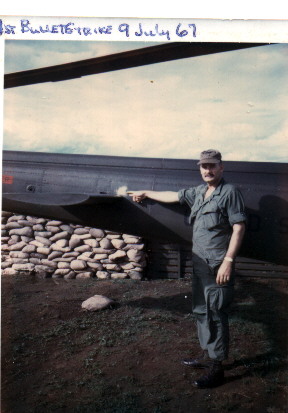
10 July 1967: Hill 830
is approximately 14 kilometers from the Cambodian Border and sits astride a
major exit from the Ho Chi Minh Trail. The 4th Bn 503rd
Inf of the 173rd Abn engaged a large, well dug-in NVA force. AVENGER
guns supported the operation in a fierce two- (2) day battle. The BN suffered 24
KIA and 62 WIA, and they found a total of nine (9) NVA dead after the battle.
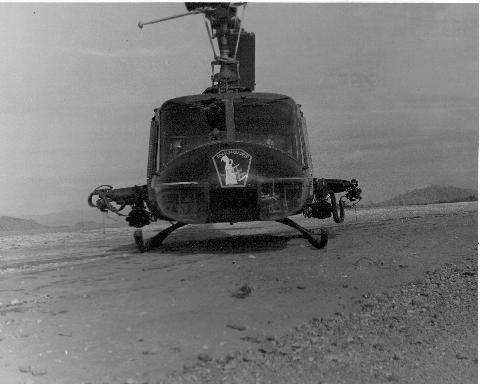
13 July 1967: While in support of the 4th Inf Div in the vicinity of
Due Co, the ground troops made contact with a superior force and were in
desperate need of support. CPT. Hooper flying AVENGER 691 served as team leader
of a fire team which arrived in the area and immediately directed and applied
suppressive fire on the enemy positions and forced the enemy to break contact
with the friendly forces. While his wingman AVENGER 693 provided suppressive
fire, CPT. Hooper went into a small landing zone to evacuate a seriously wounded
soldier. The AVENGERS claimed the first enemy kills of the company. One (1) NVA,
KIA was confirmed and an estimated thirty (30) NVA KIA were unconfirmed. CPT.
Lynn C. Hooper was awarded the Distinguished Flying Cross (DFC) for his part in
the action.

17 July 1967:
MAJ. Robert Bagley, the Executive Officer, was reassigned to IFFV. CPT. Michael
Howe assumed the Executive Officer position and LT Lonnie Welch replaced CPT.
Howe as the Intelligence Officer.
30 July 1967: CPT. Lynn
Hooper assumed command of the Gun Platoon, replacing CPT. Ernest R. Bowling.


Cpt Lynn Hooper 2005
CPT Bowling
31 July 1967: While in support of the 4th Inf Div
GHOSTRIDER 529
crashed and burned approximately ten (10) miles southwest of Camp
Holloway. Killed in the accident were
WO Arnold 0. Nakkerud (AC),
WO Glen Shropshire (P),
and
SP4 Donald W. Hart (G).
The (CE) PFC Robert E. Keyes stated that the aircraft inadvertently went IFR
during a low level pass and struck a tree in a descending left turn attempting
to return to VFR conditions PFC Robert E. Keyes was seriously injured and
evacuated to the 18th
Surgical
Hospital.
3 August 1967:
In the morning, a CIDG company made contact with two (2) NVA companies one (1)
km west of Dak Seang. A relief force also found itself under an attack which
lasted until early afternoon. Almost every night during the last half of July,
both Dak Seang and Dak Pek had been pounded by mortar, rocket and RR fire.
4 August 1967: As a result of the fighting on 3 August, the ARVN 42d Regt and
two (2) ARVN airborne battalions moved in to reinforce Dak Seang. The 189th
airlifted the 1/503rd Abn Bn of the 173rd Abn out of the
jungle near Hill 830 and inserted them at Dak Pek. The 189th also
conducted a CA for 5th SFG in the vicinity of Buon Ho. They inserted
177 pax in 168 sorties. The assault was conducted with no incidents and negative
contact.
6 August 1967: 189th conducted a CA for 3/8th Inf 4th
Inf Div in Francis Marion they moved 450 pax in 327 sorties. The assault was
conducted with no incidents and negative contact.
7 August 1967: 189th conducted a CA for 3/8th Inf 4th
Inf Div in support of Francis Marion moving 410 pax in 218 sorties. The
assault was conducted with no incidents and negative contact.
10 August 1967:
GHOSTRIDER 169
(need photo) was
completely destroyed by fire at Hensel AAF. There were no injuries as all crew
members were out of the aircraft at the time. Aircraft 169 was shut down while
being loaded with CS grenades which were dropped causing several to ignite
catching the aircraft on fire.
11 August 1967: AVENGER 552
(need
photo)
flying at 1000 feet and seventy (70) knots, received small arms fire in the
cockpit and main rotor blade. One (1) person on board was not seriously wounded
and the aircraft continued to fly.
13 August 1967: Two (2) 189th gunships received three (3) hits from
automatic weapons fire in support of Francis Marion. No injuries were
encountered and aircraft continued to fly.
17 August 1967: The 189th conducted a CA for 3/8th Inf 4th
Inf Div in Francis Marion moving 267 pax in 81 sorties. The assault was
conducted with no incidents and negative contact.
The 189th responded to a tactical emergency call from the 24th
STZ (5th SFG), requesting six (6) GHOSTRIDER and two (2) AVENGER
helicopters in the vicinity of Dak To. The mission was not accomplished due to
weather and darkness and, luckily, the ground unit was no longer in enemy
contact.
18 August 1967: The 189th conducted two (2) extractions for Co B, SFG
in the vicinity of Dak To moving 247 pax in 138 sorties. One of the extractions
was for the 24th STZ that was requested the night before. They also
conducted a final extraction for 1/8th Inf 4th Inf Div in
support of Francis Marion, 267 pax in 81 sorties were moved. Both missions were
accomplished without any incidents.
25 August 1967: GHOSTRIDER 172
(need photo) made a forced landing
approximately ten (10) miles west of Camp
Holloway with minor damage sustained
but no injuries to the crew. The aircraft was sling loaded back to Camp
Holloway and was mission ready on 27
Aug 1967.
26 August 1967: AVENGER 693(need
photo) was flying at 50 feet and
100 knots when it received one (1) round in the engine compartment from small
arms fire in the vicinity of Dak To. No injuries and the aircraft continued on
its mission.
The 189th conducted a CA for the 5th SFG in the vicinity
of Phu Tuc, 153 pax in 223 sorties. The mission was conducted with no incidents.
31 August 1967:
A reconnaissance patrol had been pinned down and surrounded by a superior enemy
force just north of the Pleiku Valley, and it was decided to get them out. CPT.
Hooper was designated flight leader for the night extraction mission. Operating
in the most marginal weather conditions, CPT. Hooper planned, coordinated and
led the successful extraction. CPT. Lynn C. Hooper was awarded the DFC for his
actions.
3 Sept 1967: MAJ. Eugene Malcoff was reassigned to the 155th Assault
Helicopter Company at Ban Me Thout. CPT. Ernest Bowling assumed command of the 1st
Airlift Platoon.
3 Sept 1967:
Avenger 690
(need photo) made a forced landing due to engine
failure. There were no injuries even though the aircraft sustained major damage.
5 September 1967:
CPT. Lynn Hooper was awarded the DFC
for action he was involved in on the nights of 31 August-1 September. MG George
P. Seneff presented the award. The GHOSTRIDERS and AVENGERS were conducting a
final extraction of the 3/12th Inf 4th Inf Div in support
of our favorite operation, Francis Marion, while CPT. Hooper was getting his
award. The slicks hauled out 522 troops in 191 sorties taking up enough time so
many of the 189th missed CPT. Hooper's ceremony.
7 September 1967: Again the 189th was called on to perform another
extraction for the 1/12th Inf. 4th Inf Div in support of
Francis Marion.
Many of the operations were put on hold due to the weather, and much of
September consisted of heavy morning ground fog, zero-zero until after 0900 hrs.
Frequent afternoon rain showers and thunderstorms with ceilings 3500-5000ft
broken, visibility to 3-7 miles. Temperatures were in the High 70s to the Low
60's.
14 September 1967: The 189th conducted multiple troop movements and
final extractions for the 1/12th, 3/8th, 4th
Inf. Div. In support of Francis Marion. The slicks pulled out 529 troops in 206
sorties with enemy contact minimal
15 September 1967:
The Company sustained its first casualties from hostile ground fire. While
investigating suspected enemy tunnels and foxholes on the daily visual
reconnaissance, GHOSTRIDER 166
(need photo) received
automatic weapons fire from four (4) individuals who were attempting to hide in
the trees. GHOSTRIDER 166 received approximately ten (10) hits wounding WO
Egekial Williams (AC) in the thigh and WO Albert Whaley (P) in the lower leg.
The observer Sgt. Lawrence Crippen received facial injuries from shrapnel. Sp4
Samuel Kravehak, the gunner, returned fire on the enemy location and claimed one
(1) enemy KIA. All wounds with the exception of WO Whaley's were superficial
and, after treatment at the 18th
Surgical
Hospital, the individuals were
released. WO Whaley was eventually evacuated to the United States.
15 September 1967: The 189th was reassigned from direct support of
the 4th Inf Div to general support of the Central Highlands. These
missions included the support of II Corps, 5th SFG and 52nd
Artillery Battalion. Operations Omega and Prairie fire were also included.
15 September 1967: Major Richard Coulter was reassigned to be S-1 of the 52nd
CAB. MAJ. Darrell Waite replaced him as Operations Officer; MAJ. Robert
Davenport became the Platoon Leader of the 2nd Airlift Platoon.
17 September 1967: MAJ. Wilbur Mixter was transferred to the 405th
Maintenance Detachment as the Detachment Commander.
21 September, 1967:
The unit was notified at 2230 hours that GHOSTRIDER 166 (need
photo)
was missing on a flight from Mang Buk Special Forces Camp to Kontum. An air
search was initiated on 22 September and the missing aircraft was located
approximately twenty (20) kilometers south of Mang Buk. All crew members
survived with minor injuries although the aircraft was completely destroyed.
1 October 1967: MAJ. George Hodges was assigned to the 189th as
Company Executive Officer replacing CPT. Howe. CPT. Howe was made the assistant
gun platoon leader.
1 October 1967: The 189th supported Operation Prairie fire, the high
stakes, top secret, cross border reconnaissance game. Across the border in Laos
and Cambodia, the rules were much different and the standards expected of pilots
much higher. Normal military protocol, rank, etc. were subordinated as natural
leaders proved they were up to the challenge. Friendships formed based on trust
and mutual interdependence. Foremost was the determination by all participants
that they would stick to the bitter end of the mission to ensure no friendly
forces were left behind in enemy territory. 10 October 1967 marked the start of
a classified mission for the 189th with the 5th SFG out of
FOB-2 at Kontum. This mission required all the skill, techniques and proficiency
the pilots and crews could muster. Charlie was not to be laughed at.
It is impossible to determine whether the GHOSTRIDERS or the AVENGERS
encountered more hostile fire on these missions. While GHOSTRIDERS were hovering
above triple canopy jungle, using Maguire rigs (ropes and slings) to extract the
teams on the ground, the AVENGERS were on station providing withering fire
support. These missions established once and for all that the NVA had developed
the Ho Chi Minh trail into a high-speed highway capable of rapid movement of men
and equipment into all parts of South Vietnam.
3 October 1967: AVENGER 552 was on a low level mission at 100 feet at 100 knots.
The aircraft took four (4) hits in the left side while in support of a SF
mission in Laos. One crew member was WIA.
5 October 1967: At approximately 0820, the 189th was notified the
gunner on GHOSTRIDER 759
(need photo)put two (2) rounds through the top of the
ship. Nobody was hurt, but the ship had to be brought back and checked out for
further damage. Also, GHOSTRIDER 153 (need photo)
piloted by WO Jones, was hovering over the dense jungle making a pick up by
ladder when a tree bent down by the rotor wash flapped back into the tail rotor
causing the aircraft to make a hard landing. The crew was not injured and the
area was secured until a CH-47 aircraft picked up the aircraft.
6 October 1967:
On a FOB-2 mission, aircraft GHOSTRIDER 171 was in support of a SF team deep in
enemy held jungle west of Dak To. GHOSTRIDER 171 (need
photo), the leading
insert ship, drew heavy automatic weapons fire wounding the pilot and almost
totally disabling the ship. WO Butler brought his AVENGER gun team in to
suppress the fire on the injured ship. After getting the troop ship safely out
of the area, they returned to mark the heaviest ground fire area with smoke to
facilitate air strikes by the Air Force. CPT. Shiver Eustice (P) received wounds
to his leg and arm and was evacuated to the 18th
Surgical
Hospital. The aircraft was left at Dak
To and arrangements were made to return the aircraft by CH-47. AVENGER 694
(need photo)
received small arms fire but, in retaliation, the AVENGERS were given credit for
27 confirmed NVA kills.
WO Richard E. Butler
received the DFC for his actions on the mission.
10-31 October 1967: Project Omega (Dak To) The first platoon of the 281st
AHC Provided three (3) UH-ID's for operations at Kontum in support of Project
Omega with the 189th AHC, staging out of Kontum, the aircraft were
utilized in the daily shuttle of a seventy two-man reaction force to New Dak To
and to stand by daily to insert the reaction force in areas where the LRRP
detected enemy activity. Three (3) assaults were made northwest of New Dak to
into Mountainside landing zones.
13 October 1967:
Company was notified that WO Nelson had been shot in the back while
participating in a operation for FOB-2 while flying AVENGER 693. (need
photo) He was evacuated
to the 18th
Surgical
Hospital and later to Cam Ranh Bay. The
aircraft did not receive any damage from small arms fire.
14 October 1967: SP4 Duffin sustained a slight bullet wound to the foot. He was
taken to the 18th
Surgical
Hospital. He was released from the
hospital quickly and returned to the unit in a few days.
The 52nd CAB was the principle supporting aviation element during
Operation Mac Arthur. The Battalion's normal daily operational commitment to the
4th Inf Div was 22 UH-1Hs, 10 UH-1Cs and 7 CH-47s of which the
majority was allocated to the 1st Brigade at Dak To.
15 October 1967:
Reports pertaining to Operation MacArthur were published showing the buildup of
enemy forces in preparation for the Battle of Dak To. During the period 15-21
October, there were several reports of small arms fire directed at aircraft in
an area twenty (20) kilometers northeast of Dak To.
15-21 October 1967:
During this period there were several reports of small arms fire directed at
aircraft in an area twenty (20) kilometers NE of Dak To. With excellent gun
coverage given by the AVENGERS and the GHOSTRIDERS, they continued to operate
successfully and effectively on the FOB 2 mission.
19 October - 9 November 1967: 5th SFG (Prairie Fire) the aircraft
used in this operation was assigned a primary mission of resupply and liaison.
In addition, the unit conducted several combat assaults. The area of operations
was southwest of Kontum where the assaults were flown into mountain landing
zones. On one such assault, a 281st AHC aircraft killed one (1)
enemy. On 9 November, the aircraft were withdrawn to Pleiku where they once
again flew in support of the 52nd CAB.
22-29 October 1967: Contact was made with an unidentified company sized unit
eight (8) km SE of Dak To. Heavy trail building activity was reported thirty
(30) km NW of Dak To. An agent reported that a 4000-man force would use the
trails to move into Knotum
Province.
24 October 1967:
Captain Howe called operations and alerted them that GHOSTRIDER 167
(need photo) had a small electrical fire and a main
rotor blade strike while evacuating troops. The aircraft was flown back to FOB-2
and left there for maintenance to check the following morning.
25 October 1967: Our turn to be supported by another company. Due to maintenance
problems, only one (1) gun ship could be supplied to FOB-2. The 165th
AHC supplied slicks and remaining guns.
27 October 1967: The 52nd conducted a battalion sized Airmobile
Operation in support of the 1/22nd Inf 4th Inf Div for
Operation Mac Arthur. The 189th participated with slicks and guns.
The mission was conducted with no incidents and negative contact.
28 October 1967:
An AVENGER gunship received three (3) hits by ground fire in vicinity of Dak To.
One (1) crew member WIA and aircraft continued to fly.
29 October 1967: Helicopter crews from the 179th Medium Helicopter
Company, 52nd CAB, 189th AHC and 604th Maint
Det provided support to recover a downed UH-1H helicopter. The helicopter
recovery operation was carried out under difficult and extremely hazardous
flying conditions. The ground party prepared a landing zone at the crash site
located in dense jungle. The maintenance crew landed at 1800 hours and prepared
the aircraft for extraction by CH-47D. The first attempt was unsuccessful
because the lifting cable was too short. A longer cable was obtained, the downed
UH-1H again prepared for extraction, and the LZ enlarged by cutting additional
trees. The CH-47D returned and the recovery was accomplished during the hours of
darkness. The GHOSTRIDERS and AVENGERS performed insertion of maintenance
personnel and gun cover. WO Niester received superficial face wounds and minor
shrapnel wounds to his arms and legs.
30 October 1967: Omega Operations terminated with all GHOSTRIDERS returning to
Camp
Holloway. Many pilots were looking
forward to continuing this mission in the future.
2 November 1967: Two (2) GHOSTRIDER slicks were assigned to participate in a CA
with the 170th and 119th AHC's.
The Battle of Dak To was a major battle of the Vietnam Conflict that took place
between 3 and 22 November 1967 in Kontum
Province, in the Central Highlands. The
189th played a major role with insertions and extractions, medical
evacuations, resupply and gunship support throughout the entire battle.
3 November 1967:
AVENGER 552 (need
photo) while on a CA the aircraft was hit in the
cockpit by automatic weapons fire. One (1) crew member was WIA and the aircraft
received structural damage and continued on the assault. GHOSTRIDERS were
notified that a new commitment was given to them. Nightly flare stand-by, two
(2) UH-1H's were required.
4 November 1967: Another mission was assigned. An area to include the western
half of a semi-circle within a 15 km radius of Camp
Holloway was to be visibly ? every day.
6 November 1967: The 4th/503rd established FSB 15 atop
hill 823 for Battery C 3/319th Artillery. Hill 823 is approximately
nine (9) kilometers from the Cambodian border and sits sat astride a major exit
of the Ho Chi Minh Trail. CH-47D aircraft to the top of the hill airlifted the
battery. Company B of the 4th /503rd were involved in a
fierce fight to secure the hill for the artillery. AVENGER guns covered the
insertion and took action to secure the hill. After the hill was secured the
four (4) rifle companies rotated the job of providing security of the FSB. Later
that day GHOSTRIDER 153 (need
photo) piloted by 1LT Hedrick landed next to a CONEX
container to off load flares. As the aircraft lifted to a hover the CONEX door
swung open and hit the stinger and caused the tail rotor to hit CONEX container.
7 November 1967:
GHOSTRIDER 160 (need
photo)
caught fire in maintenance and received major damages. Aircraft commitment
increased at FOB-2 to eleven (11) slicks and five (5) guns.
8 November 1967: In an area centered four (4) nautical miles west of Dak To, a
SF team on a search and destroy mission engaged an unknown-sized enemy force in
fortified positions.
SP5 John Adams
was (CE) aboard an AVENGER gun ship flying cover on a Special Forces insertion
mission west of Dak To. Other members of the crew were: WO McKenna (AC); SP4
Begay (G); WO Weaks (P). CPT. Hooper was team leader, he and his wingman were
circling the inserted troops, when they started received heavy small weapons
fire. WO McKenna
s aircraft was hit with small arms fire and began to lose power and attempted to
land. Failing to find a suitable landing zone, WO McKenna allowed the aircraft
to settle tail first into the trees. As the helicopter struck the trees, the
tail boom snapped off, spun and came to rest on an upslope caving in the front
of the aircraft. After his wingman crashed, CPT. Hooper called for the flight of
helicopters that just departed to return and rescue the downed crew. He
continued to attack the enemy positions despite the heavy hostile fire and
forced the enemy to withdraw from the rescue site. WO McKenna and SP4 Begay
exited the right side of the helicopter, while Weaks and Adams exited the left.
SP4 Begay suffered a broken leg, WO Weaks injured his right foot, and SP5 Adams
had a broken arm and appeared to be in shock. The four had barely exited the
helicopter when they began to receive small arms fire. WO McKenna radioed for
help, and he, SP4 Begay and WO Weaks made their way to an extraction point with
SP4 Begay dragging SP5 Adams. SP4 Begay, because of his own injuries, was unable
to carry SP5 Adams far and left him in a slumped-over position against some
bushes. SP4 Begay later stated that SP5 Adams condition had worsened. While
awaiting extraction, WO McKenna returned to the crash site to see if he could
help SP5 Adams. He saw two Viet Cong, one who appeared to be shooting at SP5
Adams. WO McKenna shot at the Viet Cong then fell down the slope to the creek
bed where he was extracted. WO Miller, upon learning the position of the downed
aircraft, immediately flew to the area. Captain Hooper advised him that the
downed crew was receiving heavy fire and that the ridge overlooking the crash
site was held by well armed and determined NVA. Disregarding the danger, WO
Miller brought his aircraft to a hover over the site of the downed aircraft and,
while under intense fire from the enemy, he directed his (CE) and SP4 Williams
(G) to cover his approach and lower the McGuire rig into the crash site below.
SP4 Williams placed accurate fire upon the enemy positions so that the rescue of
the downed crew could be completed. WO members secured themselves to the rescue
sling. He then made a slow vertical ascent under fire and safely lifted the
injured personnel from the crash site and flew them to a safe landing area for
transfer, inside his aircraft, for medical evacuation to a Pleiku
Hospital. SP5 Adams was last seen
slumped over just outside the left cargo door of the crashed aircraft.
Subsequent rescue efforts were frustrated by enemy fire, and Major Sanders
ordered all rescue attempts terminated. Following termination of rescue efforts,
the downed aircraft was destroyed to prevent capture of weapons and equipment.
The enemy broke contact leaving twelve (12) dead. SP5 Adams survived the crash
of his helicopter and, with the presence of enemy forces, stood a good chance of
being captured. His helicopter contained equipment the Army did not want in the
hands of the enemy. The decision was made to destroy the aircraft. Twelve 500
lb. bombs, six CBU-2
s, 1600 rounds of 20 mm fire, and additional bombs and napalm were dropped on
the crash site to prevent the enemy from getting equipment from the helicopter.
SP5 Adams
was declared dead on 03/13/78. All other crew members were rescued.
Cpt. Lynn Hooper received
Distinguished Flying Cross
9 November 1967:
The aircraft were withdrawn to Pleiku where they once again flew in support of
the 189th AHC.
11 November 1967: A Co. 2nd/503rd was moving along a
narrow ridge 400 meters west of the LZ when they were ambushed by NVA. AVENGER
gunships assisted in recovery of the troops. A Co. lost three (3) KIA and twenty
four (24) WIA. B Co. lost one (1) KIA and eleven (11) WIA. When the fight ended,
patrols found five (5) NVA dead along with weapons.
12 November 1967: Two (2) companies from the 503rd moved 300 meters
north of FSB 16 to secure the ridge line. They started to move west along the
ridgeline when they were once again ambushed. AVENGER and CROCODILE guns were
called to provide suppressive fire, making firing pass after firing pass putting
down intensive fire so the enemy would not break and run. The vicious fighting
lasted until the next day. The 503rd lost 21 KIA and 17 WIA. A sweep
of the area afterwards revealed 34 NVA dead and 21 enemy weapons.
15 November 1967: It appeared that the second phase of the Battle of Dak To was
on its way. At 0840 hours in Dak To, AVENGER guns were on standby waiting for
anything to happen, and they did not have to wait long. Charles decided he was
going to make sure everyone was awake, so he sent his greetings via incoming
mortars, 12 to 15 rounds landed on the parking ramp where three (3) C-130's were
parked. Two (2) of the C-130's were completely destroyed and the third damaged.
Everyone except the AVENGERS retired to the bunkers while the fire team took off
and, directed by the tower, engaged the mortar firing position. The C-130's that
burned were loaded with ammo so it was a long stay in the bunker for the troops.
The C-130's stopped burning about 1230 hours. At 1545 hours, Charlie again sent
his greeting via mortar to Dak To this time hitting the ASP setting it on fire
resulting in a complete loss of the ASP. Again, everyone retired to the bunkers
and again the AVENGERS took to the air. The ASP burned fiercely until 0130 hours
and an occasional round exploded throughout the night in very close proximity of
the bunkers. Charlie continued to send his greetings several times during the
night. In addition to isolated thunderstorms over the airfield during the night,
unreported weather was 1141 tons of various types of ammunition falling
everywhere.. Damage to the airfield was heavy but only in certain localized
areas. No injuries to 189th personnel.
15-21 November 1967:
Heavy mortar and rocket fire continued day and night. Charlie seemed to be well
entrenched in the surrounding hillside and their objective appeared to be an
attempt to inflict as many US casualties as possible rather than attempting to
over-run Dak To itself.
19 November 1967: The 2nd Bn 503rd Inf of the 173rd
Abn Bgde numbering less than 500 men were given the mission of securing Hill
875, estimated to have been defended by a company of NVA main-force troops fresh
off the Ho Chi Minh Trail. What followed was one of the fiercest battles of the
entire VN War which would later be categorized as one of the Border Battles
of 1967. The 189th AHC supported the operation with slicks and guns
during the entire battle ending on 23 November.
22-28 November 1967: During this period, enemy activity decreased significantly.
In what appeared to divert US forces from Dak To, the enemy began to increase
ambush and harassing activities in Kontum
City which was mortared on 27 November.
26 November 1967: A covert and clandestine operation was to take place in Laos
which included eighty (80) ground troops consisting of Special Forces,
Mountangards, and Nungs, were the largest SOG force that has been inserted since
working with FOB-2. It was not long before a call came in that the team was
pinned down and desperately needed ammunition, water, and entrenching tools and
to have the wounded evacuated. It was just before dusk when the flight got to
the LZ and, during the approach, the first aircraft GHOSTRIDER 628 (need
photo) took twelve (12) hits (mostly through the
cockpit), receiving heavy battle damage. The (AC) Lt Gray received multiple
serious wounds and the (P) WO Clines took a round in the leg but managed to fly
the heavily damaged aircraft back to Dak To. The other aircraft could not land
because of the intense ground fire so they made passes over the LZ tossing
ammunition and other supplies out the door. A night extraction would be
impossible so the aircraft returned to FOB-2. No one slept that night thinking
about what could happen in the morning. (Enclosure
1 Letter from CWO Boyd Clines describing the nights action.)
27 November 1967: A 5th SF unit from FOB-2was in constant contact
deep in enemy territory west of Dak To and they called for an emergency
extraction of an 80-man force that had been inserted the previous day. Their
situation was getting critical as GHOSTRIDER 6 (MAJ Sanders) and AVENGER 6 (CPT
Hooper) arrived over the position with eight (8) slicks and four (4) gunships.
CPT Hooper immediately led his fire-teams on devastating runs over the enemy
positions where the enemy was so close that the use of Air Force ordinance was
impossible. The AVENGERS made continuing firing passes at this determined enemy
and, in spite of heavy weapons fire, they were successful in forcing the enemy
to break contact. Backing up the gunship pilots with tremendous fire support
were the crew chiefs and gunners on the guns and slicks who placed heavy and
accurate fire on the enemy which protected the flank of the attacking gunships
allowing the GHOSTRIDERS to begin the extraction. Lt Gray was evacuated to Japan
then later to the US. WO Cline's went to a Quin Nhon hospital and returned to
the unit. MAJ Sanders was awarded the Silver Star, MAJ Leva and all AC's were
awarded the DFC, WO Webster, 1LT Lindsey, WO Butler, Ochotsky and others were
awarded the Air Medal with V device. (See
Enclosure 2
for statement from CPT John J Holland, SF Commander of ground troops)
29 November 1967: 189th conducted a final extraction in support of 1st
Bde 4th Inf Div in the vicinity of Dak To. They extracted 252 pax in
87 sorties. Mission was conducted with no injuries or contact.
30 November 1967: The 189th conducted a CA in support of 3/12th
Inf 4th Inf Div in the vicinity of Dak To. They lifted 585 pax in 182
sorties. The Battalion Commander of the 3/12th Inf. received a minor
facial wound when his C&C aircraft came under enemy automatic weapons fire.
GHOSTRIDER 154 was on a recon mission at 50 feet and 90 knots and received one
(1) hit through the cockpit and continued on the mission.
1 December 1967: With the completion of the FOB mission, the 189th
turned its attention to other commitments including the 4th Inf Div
and support of the 170th AHC, 119th AHC and II
Corps missions.
4 December 1967: The 189th AVENGER gunships supporting a CIDG team
received credit for nine (9) NVA killed by air.
6 December 1967: The 189th conducted a CA in support of the 1/8th
Inf 4th Inf Div, in Spaatz AO. They lifted over 255 pax in 45
sorties. The mission was conducted with no incidents and negative contact.
13 December 1967:
Dak To came under mortar attack causing extensive damage to GHOSTRIDER 156.
No injuries were suffered, however, the
aircraft could not be flown.
14 December 1967:
GHOSTRIDER 159
(need photo) took one (1)
round of hostile fire while in support of 4th Inf Div negative
injuries.
16 December 1967: While on a mission for the 4th Inf Div GHOSTRIDER
174 received one round through the tail boom, and the aircraft was flown to Dak
To for repair.
17-19 December 1967: Normal missions resumed.
20 December 1967: At 1530 hours, 189th
GHOSTRIDER 154
(need
photo)
was hovering at 120 feet lowering cutting equipment by rope. The tail rotor
struck a tree causing the aircraft to crash and burn. Two (2) crew members, (AC)
WO Mc Garry
and (CE)
David Antol
were missing along with two (2) passengers: LTC Glen Belnap and SGM Herbert
Roberts Jr. WO Baker (AC) suffered a severe cut lip. Sp4 Kornes (G) was
evacuated with a broken leg. A search for the missing crew members and
passengers had to be terminated due to darkness. The missing personnel were
declared KIA. Reports indicate that LTC Belnap on board from the 3rd
Bde 4th Inf took Antol's helmet to talk with the AC while they were
landing so there was no way to clear the tail rotor on the left. Rules were
changed after that flight so that no one could use a crew member's helmet during
flight.
21 December 1967: The 189th received a call from WO Meister that
AVENGER 697
(need photo)
had been involved in an accident at Polei Klang trying to hover between two (2)
281st AHC aircraft where INTRUDER 748 and 039, AVENGER 697 meshed
blades with 748 and was totally destroyed. (AC) of 697 was WO Ginac (P) was WO
Engle, (CE) was SP4 Tipton, and the (G) was PFC Nelson. SP5 Schenk was sitting
in a trailing helicopter and observed 697 mesh blades with 748. He raced to the
gunship and pulled the crew out from the wreckage and moved them to safety. He
returned to the stricken aircraft and successfully shut off the engine
preventing a fire. During the entire action, he was drenched with fuel and, had
a fire occurred, death or grievous injury was certain. The only injuries
sustained by the crew were head lacerations received by SP4 Tipton. Both
aircraft were a total loss. SP5 Schenk was awarded the Soldier's Medal for his
quick action in complete disregard for his own life. One (1) US soldier SP4
Paschall from the 281st AHC, INTRUDERS was KIA by flying shrapnel
from the crash. At 1530 hours GHOSTRIDER 154 crashed and burned while on a
resupply mission for the 3/8th Inf a tail rotor strike was suspected
when the aircraft came in contact with jungle canopy. WO Baker (AC) suffered a
severe cut lip. WO McGarry (P) and PFC Antol (CE) were missing. SP4 Kornes was
evacuated with a broken leg. A search was made of the area for the missing to no
avail.
23 December 1967: 189th Operations was informed that GHOSTRIDER 153 (need
photo)
was down at Dak To with a split main rotor blade. Aircraft was sling loaded back
to Camp
Holloway by CH-47D.
25 December 1967: Being Christmas day, the entire company was thinking about
family and friends at home. The mess hall had a better meal than usual, and many
toasts and many beers were consumed. No incidents occurred. However, one (1)
GHOSTRIDER slick carried Chris Noel to Camp
Schmidt to entertain the waiting
troops.
27 December 1967: At approximately 1300 hours, the 189th received a
call that GHOSTRIDER 153 (need
photo), piloted by (AC)
1LT Lindsey, was down two (2) miles west of Dak To airfield. Neither crew nor
aircraft suffered any damage, and the aircraft was sling loaded by CH-47 back to
Pleiku. The other missions ran smoothly the rest of the day. A CA in support of
the 2/503rd Abn, 173d Abn Bde was conducted in the vicinity of
Kontum. They lifted 252 pax in 42 sorties.
28 December 1967: Still in support of the 4th Inf Div GHOSTRIDERS and
AVENGERS conducted a CA, for the 1/503rd Abn, 173d Abn Bge in the
vicinity of Kontum. They lifted 120 troops in 20 sorties into a new area. The
mission was conducted with no incidents and negative contact.
29 December 1967: Normal missions in connection with the 4th Inf Div
the 189th conducted a CA with 120 troops in 24 sorties from the 3/12th
4th Inf Div Enemy small arms fire was received from the SW quadrant
of the LZ. An AVENGER gunship sustained one (1) hit with no injury to crew.
Later that day, the 189th moved 352 troops of the 7th ARVN
Bn. into a secure LZ. The mission continued with another insertion of 150 troops
and tons of cargo moved.
31 December 1967: The 189th conducted a CA in support of 3/12th
Inf and 4th Inf Div in the Spaatz AO. They airlifted 150 pax in 50
sorties. The mission was conducted with no incidents or contact.
31 December 1967: Many spent New Year's Eve in celebration, both in the Officers
and Enlisted clubs at Camp
Holloway, while others were committed
to the 5th SFG, 4th Inf Div and others. At the
celebrations, all commanders expressed their appreciation for the men of the 189th
and toasted to a job well done with many more to go. Thus closing out the
end of 1967.
Looking back on the different missions during the year showed a few problems
encountered in the first months in support of the 4th Inf Div and the
5th SFG. The 189th recognized them even though the 4th
and 5th appreciated how the unit performed for them. The coming year
would be spent in support of the same missions and operations which were
expected to be performed much smoother.
1968
January 1968:
The New Year ushered in a new lifestyle for the officers and men of the 189th.
They were able to leave inhospitable tents with their rain barrel bathtubs for
wooden hooch s with real showers right in the center of Camp Holloway. The local
VC was not ready to let the company enjoy their new quarters, with the move,
came nightly mortar attacks making it inadvisable to sleep above ground. Most
nights as many as 50 mortar rounds were lobbed onto Camp Holloway. In an effort
to stop the nightly barrage, half of the gun teams were kept on alert at night
after putting in busy, long days in hopes of silencing the mortar tubes.
2 January 1968:
Change of Command from MAJ Bobby Sanders to MAJ Neil Leva CO, MAJ William Fraker
is XO.
8 January 1968:
A GHOSTRIDER aircraft landed at a fire base SW of Dak To and, while running,
received extensive main rotor damage. An infantry detail working at the fire
base cut down a tree down and it fell into the turning blades. The aircraft was
recovered, and there were no injuries to the crew.
9 January 1968:
The 189th inserted A and C companies 1/8th Inf and
4th Inf Div into a hostile LZ that was prepped with artillery
for twelve (12) minutes and the barrage was very effective. Seven (7) GHOSTRIDER
slicks and three (3) AVENGER guns flew 45 sorties and 20 flight hours. Small
arms fire was encountered, but there were no hits or injuries.
10 January 1968:
The 189th conducted an extraction of A and C company s 1/8th
Inf and 4th Inf Div in support of Operation MacArthur, utilizing
eight (8) slicks and four (4) gunships that flew 42 sorties inserting 254 troops
west of Dak To. Although heavy automatic weapons fire was received, there were
no negative hits or injuries. They also did a final extraction of 2/503rd
Abn, 173rd Abn Bge, in the vicinity of Kontum airlifting 252 troops
in 40 sorties. One (1) GHOSTRIDER slick crashed resulting in major damage to the
aircraft, but no injuries to the crew.
11 January 1968:
The 189th conducted a CA and final extraction in support of the 1/12th,
4th Inf Div west of Dak To in connection with Operation MacArthur.
They lifted 254 pax in 42 sorties. A GHOSTRIDER aircraft crashed in the vicinity
of Dak To Receiving major damage to the aircraft but with negative injuries to
the crew. They continued to stay available and conducted another CA and final
extraction in support of the 2/503rd Abn, 173rd Abn Bge,
in the vicinity of Kontum lifting 252 pax in 40 sorties. This mission was
conducted with no incidents or contact.
12 January 1968:
The 189th conducted a series of CA s and extractions supporting the
3/8th and 1/8th Inf 4th Inf Div in Spaatz AO
lifting 777 pax in 139 sorties. The aircraft received moderate enemy automatic
weapons fire in the vicinity of Dak To. A 170th UH-1H assisted in the
lift and sustained one (1) hit from small arms fire, but the crew was not
injured and the aircraft continued to fly.
13 January 1968:
The 189th performed a CA in support of C company 3/8th Inf
4th Inf Div southwest of Dak To. The LZ was prepped by artillery for
15 minutes prior to the seven (7) slicks and three (3) gunships entering the
area. Only sporadic small arms fire was received during the insertion.
14 January 1968:
The 189th conducted multiple CA s and extractions in support of the
1/8th and 3/12th Inf, 4th Inf Div in Spaatz AO
lifting 256 pax in 43 sorties. Aircraft encountered no incidents.
18 January 1968:
The 189th conducted a CA and final extraction supporting the 1/503rd
Abn, 173rd Abn Bge, in the vicinity of Kontum airlifting 478 pax in
158 sorties. Not a bullet did fly.
20 January 1968:
The 189th conducted a CA and extraction of the 2/503rd Abn
in the vicinity of Kontum where 369 members of the unit were extracted in 62
sorties. The mission was completed without enemy contact.
23 January 1968:
The 189th conducted multiple CA s in support of the 173rd
Abn Bge, in the vicinity of Polie Kleng assaulting with 380 pax in 68 sorties.
The weather was clear and the insertion went off without a hitch.
24 January 1968:
The 189th conducted a CA and extraction for the 1/503rd,
173rd Abn Bge, vicinity of Dak To where 173 pax in 20 sorties were
pulled out and they only got shot at twice.
25 January 1968:
Early in the morning, mortar rounds began falling within the area of the AVENGER
hooch s and, before anyone could take cover and head for the bunkers, one (1)
round landed on the roof of an AVENGER hooch wounding five (5). CPT Howe took
shrapnel in the stomach and CPT Bowling took shrapnel all over. They were the
most critical of the group and evacuated to the 18th Evacuation
Hospital. MAJ Fraker had minor fragments to the scalp and right knee. Mortar
rounds continued to fall throughout Camp Holloway. After the attack the
AVENGERS, both officers and enlisted personnel spent every off-duty hour digging
bunkers so they could sleep underground. The AVENGERS had hot-spot duty on the
first night of TET and was the first fire-team airborne taking heavy fire from
lift off. The AVENGERS initially worked the East Perimeter, then were called
into Pleiku City to support a CAV element that was under enemy fire, then
diverted to Kontum to support the 57th AHC who were virtually
over-run. TET was starting, and we did not know it. All units at Camp Holloway
were alerted and told to take to the air.
25 January 1967:
After completing one (1) mission, (AC) WO Brink piloted his helicopter toward
Hill 943, which were just a few miles from the battle-scarred Dak To. WO Brink
was searching the hill for signs of enemy mortars in the dense jungle foliage.
During his second pass over the area, the AVENGER aircraft came under enemy
50-cal. automatic weapons fire. When the round struck the aircraft, it sounded
like a rocket had hit me in the tail, WO Brink remarked later. When I looked
around to check for damage, I saw red smoke was coming from somewhere. The
round had pierced the belly of his ship and hit a red smoke grenade hanging from
the radio console. Thick red smoke completely blinded the occupants of the
AVENGER aircraft. WO Brink thrust his head out of the window in search of an
emergency landing zone. The grenade, still burning, had lodged between the radio
and its carriage. The (CE) SP4 John P. Miller grabbed the hot grenade and
pitched it from the ship. They were able to land without any damage.
Enemy activity at area fire-bases and troop concentrations in outlying areas
fell to almost nothing as TET approached. In a nationwide coordinated attack,
Charlie struck every town and Provincial capital as the Vietnamese New Year
arrived. The AVENGERS flew all night long responding to requests for fire
support in the Pleiku and Kontum areas. As a result of one (1) mission near the
Kontum airfield, the AVENGERS were credited with killing 165 NVA regulars. The
GHOSTRIDERS were kept just as busy defending the Camp Holloway perimeter with
door guns stripped from the slicks. They successfully repelled a sapper attack
that followed one of the all to frequent mortar barrages. The spirit of the
unit, as a whole, was evidenced by the fact that every person not employed
elsewhere spent the night on the perimeter reinforcing the normal contingent of
guards. It was through the efforts of these men and the men of other units that
Camp Holloway was able to survive the 1968 TET offensive with relatively light
damage.
25 January 1968 to 4 February 1968:
During the TET Offensive in the Kontum Pleiku area, many men distinguished
themselves by exceptionally valorous actions while serving as Aircraft
Commanders, Pilots and crew members of AVENGER gunships. They displayed a vast
amount of courage and daring during the battle by continually providing ground
troops with direct and suppressive fire support. Their ships were hit by
hostile fire on numerous occasions, but they fearlessly persisted on
placing accurate and deadly fire on enemy positions. Crew members continually
placed suppressive fire on areas not accessible to aircraft weapons systems.
Often rearming and refueling while under mortar attack and automatic weapons
fire they performed their tasks with the highest degree of professionalism and
daring. Many of the personnel serving as pilots and crew members received the
Air Metal with V device for heroism.
26 January 1968:
At approximately 0230 hours, Camp Holloway came under attack. The initial attack
came when sappers penetrated the 88th S&S Bn perimeter, slipping by
US personnel on guard, and planted satchel charges in and around the POL area.
The sappers left charges in the 88th S&S Bn Class I, II, and IV yards
also on one ammunition pad. The mortar attack was initiated at 0245 hours
against the 52nd CAB and the 219th Avn Co. An estimated
110 to 120, 82mm mortar rounds fell in the vicinity of the aircraft parking
ramps. The attack was broken at approximately 0320 hours. Results friendly: 40
US WIA, 24 aircraft damaged, 3 major, 21 minor. VC losses: 1 KIA, 1 WIA captured
by 52nd Security Detachment.
26 January 1968:
The 189th AVENGER and 57th COUGAR gunships received twelve
(12) hits from intense enemy automatic weapons fire while covering a SOG team
that was in contact in Laos. Bullet holes were taken in the aircraft but not in
the crew. All aircraft continued to fly.
28 January 1968:
The 189th conducted multiple CA s and extractions in support of the
3/8th and 1/8th Inf 4th Inf Div in Spaatz AO.
They lifted 610 pax in 200 sorties. Some enemy small arms and automatic weapons
fire was received but no hits sustained.
As the month of January was coming to a close, a new devastating section of the
war's history was about to begin. Coming in from a long day flying the FOB II
mission on the evening of 29 January, several of the 57th aircraft
received fire as they came in over Kontum city on final for the Coliseum, the
unit's aircraft revetment area. This was attributed to the ARVN's celebrating
the arrival of TET. Throughout the night of 29 January, small arms fire could be
heard from the city as streams of bright red machine gun fire brought all
members of the 57th AHC out of their tents and to their battle
stations. The COUGARS scrambled four (4) gunships while slicks became airborne
to provide flare support. The compound as well as Kontum city was under siege.
The TET offensive had begun. When the main NVA attack came along the unit's
eastern perimeter, the company poured M60 machine gun and small arm from every
bunker. Neighboring Cavalry elements wheeled several tanks and APC s in along
the northern flank and opened up with murderous beehive rounds. Overhead,
gunships from the 57th COUGARS, along with the BUCCANEERS of the
170th AHC, AVENGERS of the189th AHC and CROCODILES of the 119th AHC from Pleiku
made pass after pass along the perimeter spewing a hail of mini gun and 40mm
grenade fire. After breaking the ground attack, they turned to the numerous
mortar positions that were spotted by blazing muzzle flashes. Rolling in on
these positions with 2.75 rockets brought great satisfaction to many gun pilots
as numerous secondary explosions resulted from direct hits. As dawn broke on the
GLADIATORS Compound and Kontum City, it appeared that the attack was over. This
assumption was quickly dispelled as throughout the day the compound was subject
to numerous sniper rounds. In Kontum the battle was waged from house to house. A
partial police of the unit's eastern perimeter accounted for 59 enemy dead. It
can easily be assumed that the actual number of enemy dead was somewhat higher.
The second night of the offensive, the battle shifted to the western neighbors,
MACV, Special Forces Team B24, and the 43d Signal Compound. The three (3) units
occupy a square section on the northwest side of Kontum City. They came under
sustained mortar and ground attack on the nights of 30 January to 2 February. At
one time the NVA took two (2) bunkers on B24's perimeter. The courageous gunship
crews, along with several other attack helicopter teams from Pleiku again saved
the day. Two (2) gunships remained in the air throughout each night as the
GLADIATORS flare ships circled overhead providing an eerie day light brightness
over all of Kontum City. The 57th compound took continual sniper fire
through 4 February when the city was finally cleared and the NVA withdrew.
Miraculously no members of the unit were killed, though 26 were wounded, none
critically. During the six (6) day period of 30 January to 4 February, the body
counts in the Kontum area reached 785 NVA troops dead.
30 January 1968:
Two (2) 82mm mortar tubes of an unknown manned force attacked Camp Holloway at
0140 hours. The duration of the attack was about thirty (30) minutes during
which time 20 to 30 rounds fell within the confines of Camp Holloway. The
location of the enemy position was visually confirmed from the HAAF control
tower and counter-mortar and AVENGER gunships were employed to neutralize the
position. However, after a three- to five- minute pause, 10 to 15 additional
rounds were received. The AVENGERS again engaged the enemy position with aerial
rocket and mini-gun fire. Incoming rounds ceased immediately after the AVENGERS
engaged them for the second time. The reaction of the AVENGERS, it is believed,
caused the enemy mortars to cease fire, and spoiled a planned ground attack. Two
hundred fifty (250) enemy personnel had earlier been reported in the vicinity of
Camp Holloway, preparing for an attack on some installation in the area. The
following morning, the same enemy element (identified as H-15 Bn) was located,
taken under fire and destroyed by AVENGER and GLADIATOR gunships. 130 VC and NVA
were reported killed by aircraft. The following personnel from the 189th
AHC were wounded in action and treated at Camp Holloway Dispensary, then
returned to duty: 1st SGT Kelly L. Alfred and SP5 Lawson Hardwick Jr.
SP4 Jerald D. Smith was wounded and evacuated to the 18th Medical
Evacuation Hospital. Five (5) 189th aircraft received minor damage
during the attack.
30 January 1968:
Having spent most of the night in a bunker or under a sandbagged bunk, CPT
Hooper came into the hooch screaming, everyone get airborne. We grabbed our
gear and headed to the flight line; we would be briefed in the air. CPT Hooper
got his fire team in the air and headed out to Kontum. Upon arriving at Kontum,
he sighted and immediately engaged numerous enemy machine gun and sniper
positions. Both ships received several hits but continued making daring low
level passes until both aircraft expended all ammo. Rearmed and airborne, the
ships were directed to proceed to a suspected rocket battalion emplacement
northeast of Kontum. On one firing pass, his ship was hit on the left front by a
37mm explosive round. His pilot WO Butler received multiple wounds in his left
leg. WO Butler permitted evacuation only after the fire team had expended their
ordinance. After braving the enemy fire and evacuating the wounded to medical
aid CPT Hooper returned to Kontum with another aircraft and continued his
assault on the insurgent forces. CPT Hooper received the Silver Star and WO
Butler received the DFC and Purple Heart for their actions at Kontum.
31 January to 1 February 1968:
The AVENGERS and other fire teams continued to engage the enemy positions,
flying numerous hours and expending load after load of ammunition, both in
Pleiku and Kontum.
2 February 1968:
CPT Hooper distinguished himself while serving as an aircraft commander of an
attack helicopter team, which was involved in an attack on an
enemy battalion in the vicinity of Dak To. Ignoring the fact that three
(3) other aircraft had already been shot down by the ever increasing enemy fire,
CPT Hooper and his wingman WO Kreutz repeatedly placed devastating fire
over the hostile positions. Due to the proximity of the friendly ground troops
to the enemy positions, they made daring passes firing their
rockets with extreme accuracy. On each of their heroic passes over the
insurgent emplacements, they superbly directed the fire of the door gunners,
which caused the enemy forces to go into a state of complete chaos. During their
firing passes, AVENGER 694 received 1 hit separating CE Shoship s middle toe
from his foot. He continued to fly for 3 more sorties before he discovered his
dilemma. AVENGER 693 received five (5) hits; two (2) crew-members were wounded.
Through the courage and personal bravery of the crew in the face of intense
hostile fire, they were instrumental in the successful defeat of
the enemy forces. Both CPT Hooper and WO Kreutz received the DFC for
their heroic actions.
3 February 1968:
Another day, another attack at the 57th AHC compound at Kontum. The
AVENGERS again spent most of the night and all day defending the camp. It was
like a turkey shoot. They kept coming out of the trees and the guns kept
shooting. There were clerks, cooks, mechanics and everyone else available
torquing rockets and the guns were averaging four (4) and five (5) ammo loads
per fuel load. The 57th AHC did not have any aircraft flyable after
the assault and Warrant Officers, some of whom were in the 189th,
were actually leading ground patrols. Those first few days were the worst but
the 57th held out with the help of the 189th.
4 February 1968:
GHOSTRIDER 158 received 18 hits from small arms fire in the vicinity of Kontum.
One (1) crew member was WIA.
5 February 1968:
The 189th continued to support missions in defense of Dak To and
Kontum during the TET Offensive.
6 February 1968:
18 rounds of 122mm rocket fire and 30 to 40 rounds of 82mm mortar outside the
Camp Holloway cantonment area attacked HAAF. No personnel injuries, two (2)
aircraft received light damage. GHOSTRIDER 066 was hit by recoilless rifle fire
in a LZ causing major damage to the aircraft. GHOSTRIDER 066 crashed outside the
perimeter of the fire base and was under heavy fire by the enemy. One (1) crew
member was WIA. GHOSTRIDER VI, MAJ. Leva, went in to rescue the downed crew. He
unhesitatingly landed in close proximity to the downed aircraft and went to it
to determine whether it was capable of flying out. Immediately, enemy mortars
fired upon him and his crew. He continued to check the aircraft and decided that
the aircraft was flyable. After directing AVENGER aircraft onto the enemy mortar
positions, he waved the AC off and despite the damage by enemy fire; the downed
aircraft was saved as he flew out of the area under heavy enemy small arms fire.
MAJ Leva received the DFC for his heroic actions after accomplishing the mission
successfully.
11 February 1968:
AVENGER 693 made a forced landing on highway 14 as a result of an engine
failure, causing minor damage to the aircraft and no crew were injured.
14 February 1968:
The 189th lifted two (2) companies of the 1/8th Inf Bn
during a CA in the vicinity of Dak To without incident. A total of 12 hours and
41 sorties were flown to lift 245 pax.
16 February 1968:
The 189th conducted a CA for the 1/8th Inf Bn with ten
(10) GHOSTRIDERS and four (4) AVENGER aircraft. Thirty (30) hours were flown to
move 250 pax in 100 sorties into a LZ in the vicinity of Dak To. Minimal ground
fire was received and the operation was conducted without major incident.
18 February 1968:
A LLRP consisting of nine (9) members was surrounded and called for extraction.
They were operating deep inside Laos when a superior NVA unit attacked them. Air
Force Tac Air bombed and strafed the area before the slicks from the 57th
AHC went in for the pickup. The AVENGERS provided helicopter gunships. After the
Tac Air had expended, the first slick went in and extracted half the team. The
second ship, piloted by LT Richard Griffith and WO John Cook followed and picked
up the remaining five (5) members. As they started out of the LZ they came under
intense hostile fire. The ship burst into flames and plummeted to the ground. At
this time the chase ship, piloted by WO John Herbold, descended into the area
and was able to pick up LT Griffith, WO Cook, the crew chief and one (1) member
of the LRRP team. The remainder of the patrol and the gunner perished in the
fire. AVENGER 092 received hits in the cabin area, causing light damage to the
aircraft and no injuries to the crew. WO Cook died two (2) days later of the
burns he had suffered in the fire. WO Herbold was later awarded the
Distinguished Flying Cross for his heroism. S/SGT Fred W. Zabitosky was
nominated for and received the CONGRESSIONAL MEDAL OF HONOR for his heroism in
this action. (His citation for the Medal is Enclosure 3).
22 February 1968:
This day proved to be a true test of the 189th ability to coordinate
and execute a number of CA's and final extractions. Three (3) different
operations were performed with some aircraft being used on more than one
mission. The first was an extraction of the 3/8th Inf Bn utilizing
seven (7) GHOSTRIDERS and four (4) AVENGERS. Eighty-four (84) pax were lifted in
28 sorties the second was a final extraction of the 1/8th Inf Bn with
eight (8) GHOSTRIDERS and two (2) AVENGERS. A total of twenty two (22) hours
were flown to complete the operation. The third mission for the 189th
was a CA for the 3/12th Inf Bn utilizing four (4) GHOSTRIDERS and two
(2) AVENGERS. Two-hundred and fifty-two pax were lifted in eighty-four sorties
(84). Small arms fire was received during the initial assault; however, there
was no damage to aircraft or crew. All extractions and insertions took place
just west of Dak To in a heavily defended area. Seems like the NVA and Viet Cong
like to dig deep holes in the ground, craw in them and defend them, then we have
to dig them out, not fun.
24 February 1968:
AVENGER 691 crashed at Old Dak To. The aircraft was a total loss. Crew was not
injured.
25 February 1968:
The 189th AHC picked up 342 pax from the 1/8th Inf. Bn.
With nine (9) GHOSTRIDERS and two (2) AVENGERS just southwest of Kontum and
relocated them northwest of Dak To. 116 sorties were flown to complete the
mission.
27 February 1968:
GHOSTRIDER 172 was hit twenty (20) times in a heavily armed area deep in enemy
territory. The aircraft made a forced landing, causing moderate damage to the
aircraft and two (2) crew-members were injured. GHOSTRIDER 174 had an engine
failure and crashed eight (8) miles south of Ban Me Thout. The aircraft was a
total loss, negative injuries to crew.
28 February 1968:
The GHOSTRIDERS conducted a final extraction of the 1/12th Inf Bn six
(6) GHOSTRIDERS and two (2) AVENGERS moved 110 pax in 52 sorties from YB007289
to YB007218. The operation was completed without incident.
29 February 1968:
AVENGER 690 received five (5) hits of enemy fire in the vicinity of ZB160050.
The aircraft received light damage; one (1) crew member was WIA. A second
extraction of 224 pax from the 3/8th Inf Bn from ZB 003213 to
ZB140075, with six (6) GHOSTRIDERS and three (3) AVENGERS. Heavy automatic
weapons fire was received in the LZ. One (1) AVENGER received several hits and
one (1) crew member was wounded. Ninety seven (97) sorties were flown to
complete the operation.
During the month of March the unit encountered two problems in maintaining its
top-notch performance. The first was weather, and the second was during this
period the Vietnamese burned their fields in preparation for the growing season.
The smoke from this burning created a dense smoke which on some days reduced
visibility to only two (2) or three (3) miles.
1-4 March 1968:
Seems Charlie had Camp Holloway figured out and he would lob 15 to 20 rounds of
82mm mortar fire into the Camp every night. The perimeter would be reinforced
and guns would fly.
3 March 1968:
The 189th conducted a final extraction for the 1/8th Inf
Bn From YB972267 to YB953238 with nine (9) GHOSTRIDERS and four (4) AVENGERS.
391 pax were lifted in 134 sorties. The unit was initially extracted to a fire
base with further extractions to be continued by CH-47A's due to a TAC emergency
crisply CH-47A's were not available and a second secure to secure lift had to be
made by the GHOSTRIDERS to the final LZ.
7 March 1968:
The 189th supported the 3/12th Inf Bn with eight (8)
GHOSTRIDERS and four (4) AVENGERS to execute an extraction from YB857269 to
YB888152. 210 pax were airlifted in 35 sorties. Automatic weapons fire was
received in the LZ, but no aircraft or personnel were injured.
8 March 1968:
The 189th supported the 1/8th Inf Bn with five (5)
GHOSTRIDERS and two (2) AVENGER aircraft. Ninety (90) pax were airlifted from
ZB00243 to ZB010219 in forty (40) sorties. Another extraction was conducted in
support of the 3/12th Inf Bn utilizing five (5) GHOSTRIDER and two
(2) AVENGER aircraft, forty five (45) pax and one (1) ton of cargo were
airlifted from YB887289 to ZB010219, 18 sorties, were flown to complete the
operation. Camp Holloway got mortared again.
11 March 1968:
AVENGER 693 crashed and burned as a result of engine failure and was forced to
land in an unimproved area in the vicinity of Kontum. The aircraft was on a
combat support mission, providing fire support to a ground unit. On its way back
to base, the aircraft developed a mechanical problem. The command pilot of the
aircraft, CWO Elmer Lauck, was the gun platoon maintenance officer. He flew to
the base of a sister unit, diagnosed the problem and decided to fly the twenty
(20) miles back to Pleiku to insure that the aircraft would be available as soon
as possible. Tragically, shortly after takeoff, the engine failed. The pilot
attempted an auto-rotation and the aircraft stuck a wire fence that was
invisible in the low light, causing the aircraft to crash. As the helicopters
were in part constructed of magnesium, filled with jet fuel, and the engine was
hot, the results of most crashes were a high temperature fire. The aircraft
crashed onto its left side trapping the (AC)
CWO Lauck,
the (CE)
PFC Albert
Andrews
and the (P) WO Ron Fish. The (G) SP4 Meade pulled himself clear and with smoke
blocking his vision started to run from the aircraft. He looked back and saw he
was alone. Imagine this gunner, SP4 Meade was about 5 feet tall and maybe
weighed a hundred pounds. Still he raced back to the burning aircraft, grabbed
the 6' 2, 180 pound bloody pilot WO Fish, tore off the shoulder harness and
while his own clothing was actually smoldering, pulled the co-pilot away from
the burning aircraft. Once he reached a safe distance, he dropped the bloody
unconscious pilot and tried to run back to the burning aircraft when ammunition
in the aircraft started exploding. He could not get close to the burning
aircraft and rescue anyone else. Fortunately a passing aircraft landed and
picked up the two (2) and flew them to the Pleiku field hospital. Maj. Leva
landed at the crash site shortly after they were evacuated and attempted to
reach the burning aircraft; however, the heat actually started melting his
helmet face mask. The burning aircraft exploded. WO Elmer Lauck was prior
Special Forces; he served in VN with the 5th SFG before going to
flight school.
13 March 1968:
This day proved to be a very busy day for the 189th two (2) CA's and
two (2) extractions were performed utilizing six (6) GHOSTRIDER and three (3)
AVENGER aircraft. The aircraft extracted the 1/3rd Inf. Bn from Polei
Kleng to Dak Pek. Thirteen (13) sorties were flown to move thirty (30) pax
without incident. Then they inserted 76 pax from the 3/8th Inf. Bn.
Kontum to a LZ just west of Polei Kleng in 28 sorties. Automatic weapons fire
was heavy; GHOSTRIDER 044 took seventeen (17) hits of 30-caliber fire in the
vicinity Polei Kleng. The aircraft received heavy damage and one (1) crew member
was WIA. Later in the day seventy-six (76) pax from the 3/8th had to
be extracted from Polei Kleng back to Kontum, because of heavy weapons fire
received in the LZ. Many aircraft were hit but the extraction was performed
without casualties.
15 March 1968:
The 189th conducted an extraction with eight (8) GHOSTRIDER and two
(2) AVENGER aircraft in support of the 1/22nd Inf Bn and eighty-two
(82) pax were airlifted from ZA095535 to ZA195665. The operation was completed
without incident.
17 March 1968:
During a command and control mission WO Brooks flying as (AC) was requested to
land. While hovering in a clear area, one passenger jumped from the aircraft
without permission and the aircraft shifted causing the tail rotor to strike a
stump. GHOSTRIDER 628 began to spin, and then crashed and burned, it was a total
loss. The (CE)
SP4 David L
Groves
was KIA. All other crew and passengers were rescued.
21 March 1968:
The 189th supported the 3/8th Inf Bn during a CA with nine
(9) GHOSTRIDER and four (4) AVENGER aircraft from ZA0278928, ZB000045 and
ZB034036 to ZA939912. Three hundred and forty (340) pax were airlifted in 136
sorties. Enemy small arms fire was received about 200 meters north of the LZ
causing only slight damage to the aircraft. Also that day AVENGER 696 sustained
incident damage on take-off from HAAF refueling area.
26 March 1968:
The 189th supported the 1/22nd Inf Bn with ten (10)
GHOSTRIDER and three (3) AVENGER aircraft during a CA in which 192 pax were
airlifted in 72 sorties from ZA065308 and ZA055357 to ZA077378. Small arms and
automatic weapons fire was received in the LZ. GHOSTRIDER 162 received eight (8)
hits from 30-caliber automatic weapons fire causing light damage to the aircraft
and one (1) crew member was WIA. Later that day another CA was performed with
the 3/8th Inf Bn with eleven (11) GHOSTRIDERS and five (5) AVENGERS
from ZA128962 and ZA130970 to YA939913. Two hundred and sixteen (216) pax were
lifted in 72 sorties.
28 March 1968:
After some thought and planning the 1/22nd Inf Bn decided they needed
to do a CA and extraction from ZA079375 and ZA055357 to ZA113283. Two hundred
and fifty troops were airlifted in ninety (90) sorties without incident.
3 April 1968:
Det. C-2/5th SFG requested two (2) CA's one (1) consisting of 170
troops from AR763503 to ZA904742 utilizing seven (7) GHOSTRIDER and two (2)
AVENGER aircraft. The insertion was made in 36 sorties, during the assault enemy
small arms fire was taken in the LZ only minor damage was received by the
aircraft. The operation was a success. The other CA was to move 102 troops from
YA31454 to YA56533 utilizing the same number of aircraft. The troops were moved
in 26 sorties and it was completed without incident.
4 April 1968:
HAAF, the 52nd CAB received 40 rounds of 82mm mortar fire that
impacted the CH-47 parking area. Three (3) CH-47's were damaged to include other
miscellaneous equipment. There were no personal injuries during the attack.
7 April 1968:
The 189th supported 42nd ARVN Regt with seven (7)
GHOSTRIDERS and two (2) AVENGER aircraft to extract 365 pax from ZB049156 to
ZB045225. Eighty (80) sorties were flown to complete the operation without
incident. The extracted unit was re-supplied and equipped at ZB045225 and the
unit performed a CA to ZB045118 and ZB058124.
11 April 1968:
Five (5) GHOSTRIDER and two (2) AVENGER aircraft performed an extraction of 171
pax for Det C-2/5th SFG from YA804734 to AR765498, no enemy contact
was made.
12 April 1968:
six (6) GHOSTRIDER and four (4) AVENGERS moved Eighty-five (85) troops for Det
C-2/5th SFG from YB952683 to ZB014713. No enemy bullets were encountered.
15 April 1968:
MAJ William W. Fraker assumed command of the 189th AHC.
15 April 1968:
The GHOSTRIDERS supported the 2/35th Inf. Bn. On a CA with seven (7)
slicks and two (2) guns moving 158 pax with 44 sorties from ZA035927 and
ZA063911 to ZA155937. There were two (2) blade strikes and a busted skid during
the operation. Charlie decided to not make contact that day.
19 April 1968:
While serving as an (AC) on a AVENGER aircraft CWO Butler was escorting an
unarmed helicopter during a mission to extract a LRRP that was in heavy contact
with the enemy near Dak To. Arriving over the contact area,
he encountered a heavy volume of enemy small arms and automatic weapons
fire while encircling the trapped team. Continuing to engage the enemy, his
murderous barrages of rocket fire caused the insurgent troops to break contact
and withdraw, thus enabling the rescue helicopter to enter and depart the
landing zone safely. After the evacuation helicopter safely left the area, CWO
Butler returned to the scene and totally silenced the enemy with his aircraft
armament systems. CWO Butler was awarded the DFC (2nd Oak Leaf
Cluster).
20 April 1968:
A LRRP team sighted an enemy force preparing an anti-aircraft position. While
serving as team leader of an AVENGER fire team, CWO Butler located the enemy
position by flying low over the area. On his first firing pass on the enemy
position, he encountered heavy enemy fire. Although his aircraft received many
hits, he relentlessly attacked until the enemy position was totally destroyed.
The friendly patrol on the ground then informed him that they had to be
extracted and he volunteered to cover the extraction helicopters, despite
furious enemy fire, his attack with rocket and minigun fire insured the safe
recovery of the aircraft by suppressing and diverting the enemy fire. Only after
expending all the aircrafts ammunition did he retire from the fray. CWO Butler
was awarded the DFC (3rd Oak Leaf Cluster).
22 April 1968:
An AVENGER aircraft piloted by (AC) WO Kreutz and (P) WO Fish crashed after
engine failure. All did a good job of crashing. SP4 Nelson, the gunner, got a
bruised arm and no one else was hurt. The accident was the third (3) in six (6)
weeks for WO Fish so MAJ Fraker made him his new Assistant Commanding Officer.
25 April 1968:
A GHOSTRIDER aircraft had an engine failure WO Leary (AC) did a beautiful job
and put it down without a scratch. MAJ Fraker rewarded him for his good job by
being put in the AVENGER gun platoon.
26 April 1968:
Another busy day for the 189th as two (2) CA's had to be performed
using the same aircraft. Seven (7) GHOSTRIDER and four (4) AVENGER aircraft
moved 103 troops of the 3/12th Inf Bn from ZB015216 to YB852187 in 38
sorties. Then another 103 troops from the 3/8th Inf Bn were airlifted
from ZB015216 to YB882291 in 42 sorties. Both missions were completed without
incident.
28 April 1968:
AVENGER 263 was hit three (3) times with enemy small arms fire in the vicinity
of FSB-16 while supporting Operation Greeley. One (1) crew member was WIA, and
the aircraft received light damage.
16 May 1968:
A slick from another unit crashed and burned at FSB 5 in support of Operation
Greeley. Witnesses from the 189th said it was over-gross, and the
crew was over-confident, and they are the luckiest six (6) people in the world.
The aircraft was destroyed but the crew survived. On that same day WO Spofford,
WO Ronyak and WO Martinak thought they would show all aviators at Pleiku how to
make you known. So they decided to do a fly-by of Holloway AAF. Everyone thought
it was neat, except MAJ Fraker.
21 May 1968:
The 189th AHC had an IG Inspection. All the troops and aviators that
were not flying had to stand tall and act like they knew what they were doing.
It must have worked because they passed with flying colors.
25 May 1968:
A and C Company 1/8th Inf were attacked from the south-southwest and
west by elements of the K-4 Bn, 95C Regt. AVENGER gunships were called in to
suppress enemy fire and, after heavy contact the ground force, counted 149 NVA,
KIA. WO Zima shot himself in the hand with his own pistol. Not a smart thing to
do.
1 June 1968:
The 189th picked up the FOB-2 mission out of Kontum. GHOSTRIDER and
AVENGER aircraft were committed to the 5th SFG to support insertions
and extractions of LRRP teams in Laos and Cambodia with the intention of
disrupting traffic on the Ho Chi Minh Trail.
10 June 1968:
Dak Pek Special Forces Camp received intense enemy fire from 60 and 82mm mortars
75mm RR, and 122mm rockets. The size of the unit making the attack as well as
the weapons employed in the ground attack indicate that major elements of the 2nd
NVA Div had returned to Dak Pek. AVENGER gunships made pass after pass laying
down intensive rocket and minigun fire in support the SF Camp.
13 June 1968:
SP4 Gambone shot himself in the leg with his 30-caliber machine
gun-accidentally. Totally ashamed for what he did, he would not look at MAJ
Fraker when he visited him in the hospital. Fortunately it was a clean wound and
he went back to the unit within a week.
13 June 1968: Sergeant Donald L
Torres was awarded the Army Commendation Medal with V Device.
For heroism in connection with military operations against a hostile
force. Sergeant Torres
distinguished himself by exceptionally valorous actions while serving as crew
chief on a helicopter engaged in the evacuation of a ground unit in contact with
the enemy west of Dak To. As the
ship approached the landing zone, it received heavy automatic weapons fire.
Air strikes by Air Force aircraft failed to decrease the concentration of
fire directed at the approaching helicopters.
Sergeant Torres accompanied his ship s approach by placing accurate
machine gun fire on the enemy positions.
He continued to brave the incessant hostile fire to direct the loading of
the aircraft and assisted the aircraft commander by guiding his movements into
and out of the landing zone.
16 June 1968:
MAJ Fraker with his great scrounging skills was able to get 20 pounds of popcorn
for the Red Cross at the 71st Evacuation Hospital. It was used to
cheer up injured troops staying in the hospital. The 189th was
credited with the donation. They also received 2 pallets of 17 lb warhead
fleshette rockets at FOB-2.
18 June 1968:
(AC) WO Dillmore and (P) MAJ Fraker flew number one (1) insert ship into a LZ
where no aircraft had successfully inserted a team without incident. Two (2)
helicopters were shot down in previous attempts to enter the LZ. Small arms fire
was received but only slight damage to aircraft and no personnel were injured.
Later in the day, MAJ Fraker had his first opportunity to fire fleshette rockets
in an AVENGER aircraft in support of the same mission.
25 June 1968:
The GHOSTRIDERS and AVENGERS with C&C in the hands of MAJ Fraker flew all day in
support of FOB-2, making one (1) extraction and two (2) insertions.
30 June 1968:
This day marks 45 days without an accident under MAJ Fraker s command. He bought
champagne for his pilots to celebrate. The big spender bought 12 bottles at a
cost of $1.25 a bottle, for a grand total of $15.00. At the time everyone
thought it was great, until they found out how cheap he was, but to give him a
break, it was probably all he had in his wallet.
6 July 1968:
SP4 Robertson shot himself in the leg with his own 38-caliber pistol. Not smart.
9 July 1968:
MAJ Fraker and SSG Tomessetti took a truck full of food to the orphanage at Tu
Tam. They talked with Sister Gisele about a generator and a new building. MAJ
Fraker was hopeful that the unit could get the materials needed to construct the
building.
13 July 1968: 1st LT Uwe
Lindner was flight lead for a flight of four aircraft of the 189th
Assault Helicopter Company supporting the 5th Special Forces Group in
an operation west of Dak To. The
unit had been called upon to make an emergency extraction of a 12 man
reconnaissance team whose position had been compromised and were evading a
superior enemy force that was in hot pursuit.
This mission was being controlled by a FAC on the scene that knew of the
teams position and was to guide the group in.
Overhead, Air Force A1E Sky raiders were there to provide air cover if
necessary and helicopter gunships of the 189th AHC flew cover and
provided close support for the slicks.
The FAC preceded the flight and established an orbit over the general
area of the team. The team was
spotted and the FAC started drawing enemy fire.
The A1E Sky raiders were called in and the fleeing team took cover while
the Air Force brought in their ordinance on the enemy positions.
The team in its hasty withdrawal had become separated and several landing
zones were necessary. As soon as
the Sky raiders withdrew, the gunships set up a protective orbit and the first
ship came in for the pickup. The
landing zone was located in dense jungle and was a very confined area.
Landings were made to the ground in the most delicate of maneuvers for
helicopters. The surrounding jungle
was so dense that the helicopters had to literally out their way to the ground,
clearing very small foliage and cutting down the tall grass in the LZ.
In all, three separate pickups were successfully completed in different
locations and all of the dispersed team members were recovered.
This was accomplished with no significant damage to the ships involved
and no injuries to any of the rescued men.
Due to the highest order of determination and skill of the pilots and
crews of the aircraft was this emergency terminated in the face of a superior
enemy force and the most taxing of flying conditions.
Sergeant Donald Torres, Crew Chief awarded the Army Commendation Medal
with V Device.
14 July1968:
Three (3) GHOSTRIDER aircraft were called out to do an emergency extraction in
Laos. Members of FOB-2 were in trouble and had to be taken out. These men, WO
Wallin R Haber, WO Christain A Peterson and 1LT Daniel L Bradshaw assisted their
AC's in maneuvering the ships into a small jungle clearing, cutting through
dense foliage, evading enemy fire to land and allowing the ground personnel to
board their ships. They directed and aided the crew members in the performance
of their duties. Through their brilliant teamwork, they contributed immeasurably
to the success of the mission. All three (3) received the Air Medal with V
Device. AVENGER gunships covered the extraction.
15 July 1968:
The 189th made two (2) insertions for FOB-2 in the vicinity of Dak
Pek. The slicks going into the LZ received ground fire. MAJ Fraker was flying
with the AVENGERS and was providing fire support with fleshette rockets. The
body count was 146 NVA, KIA and zero (0) for the good guys. The boss says,
fleshette rockets are here to stay.
5 August 1968:
After 80 days without a accident, WO Dobbs and WO Bradshaw banged up GHOSTRIDER
252 at An Khe.
11 August 1968:
MAJ Fraker and a few men from the company went to the orphanage. They took a
bunch of school supplies, clothes, toys and other items. The men were close to
finishing the fence around the orphanage. Slowly materials such as cement and
lumber were being gathered to build the new building.
28 August 1968:
(AC) 1LT Liner was maneuvering the aircraft in the LZ looking for a landing
place and the aircraft had a main rotor blade strike. (P) Was WO Licina.
31 August 1968:
After approach to the LZ, (AC) WO Wiles was hovering the aircraft to find a safe
place to land when the main rotor struck a small tree.
1 September 1968:
CWO Kreutz was (AC) of an AVENGER gunship providing aerial fire support to a
LRRP team in heavy contact with a numerically superior enemy force near An Khe,
Even though his aircraft was under constant hostile fire and received many hits,
he remained on target and made pass after pass giving protective fire to the
distraught team members allowing them to move to a defendable position. Only
when his ammunition was expended did he desist. CWO Kreutz courage under fire
contributed immeasurably to saving the LRRP team from certain annihilation. CWO
Kreutz was awarded the DFC (First Oak Leaf Cluster) for his valorous action on
the mission.
7 September 1968:
The FOB-2 mission was turned over to the 57th AHC. The FOB-2 mission
was to insert and extract LRRP teams in Vietnam, Laos and Cambodia. By October
the GLADIATORS and COUGARS had completely taken over the FOB-2 mission from the
GHOSTRIDERS and AVENGERS of the 189th AHC. Aircraft requirements for
the mission included eight (8) slicks and four (4) gunships for FOB-2, with the
remainder of the 57th AHC aircraft allocated to miscellaneous
missions.
13 September 1968:
WO Peterson serving as (P) on a GHOSTRIDER slick during a mission to extract a
five (5) man LRRP team that were under heavy enemy fire near Duc Co. Through his
alertness he initiated the successful recovery by spotting the exact location of
the patrol on the ground. While flying through intense hostile fire, he directed
his door gunners to fire onto enemy positions, affording the patrol the
necessary cover to board the aircraft. With the entire patrol on board, he flew
his ship, hit several times by small arms fire and critically leaking fuel to
the 71st Evacuation Hospital. For his heroic actions WO Peterson was
awarded the DFC.
15 September 1968:
The 189th inserted troops of the 3/8th Inf into two (2)
fire bases and later in the day one (1) company of CIDG west of Plei Mrong. MAJ
Fraker flying with WO Nilmeier made two (2) LRRP insertions, a medevac and a
LRRP rescue in a thunderstorm with the aid of the AVENGERS. In the middle of the
night, Charlie decided to launch a few rockets and mortars into Holloway. No
rest for the weary.
18 September 1968:
The 7/17th CAV was supporting a GHOSTRIDER insertion of troops with
gun support. They were called into place fire on the enemy and friendlies were
shot, one (1) KIA and three (3) WIA with two (2) rockets. WO Nilmeier was in the
LZ when it happened. Witnesses described an OH-6 shooting.
21 September 1968:
GHOSTRIDER 370 was on take-off from the LZ at forty (40) feet and fifteen (15)
knots when the aircraft was hit in the mid area by a B-40 rocket causing an in
flight fire, the aircraft crashed and was destroyed. (AC) WO Brooks, (P) WO
Crammey who received minor injuries were checked at 71st Evac
Hospital and released. (CE) SP4 Silversmith sustained 1st and 2nd
degree burns when aircraft crashed and burned. His left eye was injured and
operated on at the 71st Evac Hospital. He was evacuated to Japan on
23 Sept. (G)
SGT Roscoe L
Prosky
was KIA. Shortly after the crash of 370, GHOSTRIDER 473 was making an approach
to drop a fire extinguisher and at 60 feet off the ground, the aircraft was hit
by another B-40 rocket in the tail boom. (AC) WO Nilmeir was able to land the
aircraft in a upright position. SP4 McGarity had been on the right side of the
ship and received the greatest impact of the explosion since the rocket hit the
aircraft just aft of the fuel cell. He was pulled out of the ship by WO Gillis.
McGarity received major injuries from the explosion. He lost both of his legs
from the knees down, loss of both eyes, broke both arms with nerve damage to the
right arm, fragmentation wounds to head and arms. He was medevaced to Japan 25
September. WO Nilmeir received fragmentation wounds in the left calf, right
foot, ankle and injury to the right eye and was transferred to Japan 24
September. WO Gillis broke his wrist and was checked out and released from 71st
Evac Hospital. SP4 Taylor, from the 604th Maint Det received 1st
and 2nd degree burns on his face and arms and he was evacuated to
Japan on 23 September. All crew members were submitted for Silver Stars and
DFC's. Kenneth McGarity, Specialist Four was awarded Air Medal (First Oak Leaf
Cluster) with V Device; Robert E Taylor, Specialist Four (Enclosure 4 is a
detailed report of the mission from XO, CPT Murray). (Enclosure 8 is a statement
by Colonel Richard I. Wiles)
23 September 1968:
The aircraft UH-1H 66-16531 was a medevac helicopter belonging to the 283rd
Medevac Detachment in for repair to the 604th TC. The main rotor hub and one
blade had been changed and some sheet metal repair completed. Two run-ups had
been completed on the aircraft that morning for tracking by CWO Jesse Hill,
quality control officer of the 604th TC. After the lunch hour WO Cahela
approached the aircraft and pre-flighted for test flight. Six (6) people boarded
the aircraft for the test flight. There were no seats or safety belts aboard the
aircraft for passengers, only the pilot and copilot positions had seats and
safety belts. After checking the aircraft in the hover test area for
approximately five (5) minutes, WO Cahela departed Camp Holloway Airfield for
the big rice paddy area approximately four (4) miles to the southeast of
Holloway. Upon arrival in the area WO Cahela made an autorotation to the west,
completed the autorotation and initiated a takeoff to the west. After forward
speed was attained, a sharp cyclic climb was observed to an altitude of 300 or
400 feet, followed by a sharp right turn to the east. That caused all passengers
to rise in the aircraft with one (1) passenger hitting the ceiling of the
aircraft as it started down in an autorotation. Once forward speed was attained,
WO Cahela banked the aircraft steeply to the right; a bank followed the right
bank immediately to the left, very steep, probably in excess of 60 degrees. It
was during the left bank that one (1) passenger observed the main rotor blade
strike the ground. When the main rotor struck the ground the main rotor blade
snapped and caused severe mast bumping, separating the rotor head and remaining
portion of rotor blades from the aircraft at an unknown point during the crash
sequence. The main rotor head with remaining portions of the rotor blades came
to rest six (6) feet past the junction of four (4) dikes. The ship exploded
during the crash and fire consumed the aircraft. Except for the main rotor
blades and hub, all major components of the aircraft were at the crash location.
(P) WO Gerald Cahela, (CE) PFC John M White, and passenger SP5 Jack Sizemore Sr,
were all KIA. Passengers D R Chrisman, E4 W L Badley, E4 B Hauer were injured.
3 October 1968:
Major Robert N Morrison assumed command of the 189th AHC.
2 November 1968:
AVENGER 244 was in close support of an insertion when it took one (1) hit of
automatic weapons fire through the main rotor blade. The aircraft continued and
accomplished its mission.
5 November 1968:
The 189th GHOSTRIDERS and AVENGERS performed an insertion south of
Duc Co for the ARVNS under II Corps Command. During the insertion, extensive
enemy small weapons and anti-aircraft fire was encountered at the LZ.
Crewmembers from the slicks and gunships displayed tremendous bravery because of
the amount of weapons fire being received, by staying on station until all ARVN
troops were inserted. The following crewmembers were awarded the Declaration of
Merit before II Corps for the Cross of Gallantry with Gold Star. 1LT Charles T.
Daily, 1LT Stanley B. Albrecht, WO Odis J. Lambright, WO Terry G. Opdahl, 1LT
Curtis C. Parsons, WO James T. Hattan, WO Brent L. Hanawalt, WO Thomas L. Locke,
SSG James L. Smith, SP5 Jose Martinez Jr, SP5 Gilbert Carrillo, and PFC Louis T.
Frye.
6 November 1968:
While returning from an insertion of a LRRP, (AC) WO Cranney and (P) Stasiewski
were notified that another LRRP team was in contact with a superior enemy force
and had to be extracted at once. WO Cranney headed for the location just SW of
the Oasis, a 4th Div FSB twenty (20) miles SW of Pleiku. When WO
Cranney's aircraft arrived at the site AVENGER gunships were already on station
giving the LRRP team heavy fire support. WO Cranney was in contact with the team
on the ground and told them he was going into the LZ. He also instructed his (G)
SP4 Ciosielski, and (CE) SP4 Roach to suppress the enemy fire with M-60 machine
guns. While the team was boarding the aircraft, the ship received small arms
fire. The door gunner brought the hostile fire to a halt when he got a confirmed
kill on a NVA soldier who exposed himself for a better firing position. Due to
the courage and teamwork of the AVENGER crew the LRRP team was returned safely
home with a wealth of war stories. Later that day LT Hedrick was piloting
GHOSTRIDER 153 and landed near a CONEX container to off-load flares. As aircraft
picked up to a hover the CONEX door swung into tail stinger and caused tail
rotor to hit Conex container.
13 November 1968:
The 52nd CAB conducted a Battalion size CA and FSB move in support of
the1/8th Inf, 4th Inf Div, in Spaatz AO. The aircraft,
twenty-four (24) UH-1H slicks, four (4) UH-1C gunships, and nine (9) CH-47A
Chinooks were used to move 550 pax and 143 tons of cargo in 437 sorties. Fog and
enemy automatic weapons fire delayed the lift for one (1) hour. One (1) UH-1H
slick was hit with an enemy B-40 rocket and destroyed. All crewmembers were WIA
and medevaced. Late into the night Camp Holloway received twenty (20) rounds of
122mm rockets. There were four (4) US WIA, 1 UH-1D helicopters destroyed, three
(3) CH-54's with light damage, eight (8) UH-1H's with moderate damage, two (2)
UH-1H's with light damage and numerous buildings with varying amounts of damage.
15 November 1968:
On an insertion of a 4th Div LRRP west of Duc Co, GHOSTRIDER 22
piloted by 1LT Phillip Ahneman, received an emergency call from a downed Birddog
of the 219th Aviation Company, call sign HEADHUNTERS. The HEADHUNTERS
had experienced an engine failure and were forced to ditch the aircraft in the
only suitable open space, a soft river bottom. The ever-present threat of
Charlie turned what would have normally been a routine forced landing into a
race for safety. 1LT Ahneman and his crew, 1LT Robert Acklen, SP5 Joseph Meeks
and SP4 Tony Gambone, immediately recognized the problem and made a quick change
from the role of CA helicopter to that of a medevac helicopter. They picked up
the pilot and his observer from the river, a little wet and shaken but very
grateful.
16 November 1968:
The 189th airlifted an eight (8) company CA near Duc Co in western
Pleiku Province.
18 November 1968:
The 189th extracted five (5) companies from Duc Co AO. That evening
Camp Holloway received three (3) 122mm rockets with negative casualties or
damage.
20 November 1968:
The 189th inserted six (6) companies into hostile positions in Pleiku
Province. During the insertion GHOSTRIDER 175 experienced complete loss of
anti-torque control and began a turn to the right. Aircraft would not streamline
and continued right turns, completing five (5) revolutions. The (AC) entered
autorotation, and it settled into a small clearing. The accident was caused when
the number two (2) tail rotor drive shaft hanger bearing failed.
22 November 1968:
An AVENGER gunship received four (4) hits from heavy automatic weapons fire in
Laos. One (1) crewmember was WIA, the aircraft continued to fly.
4 December 1968:
A 189th AVENGER fire team supporting a CIDG team received credit for
nine (9) NVA killed by air.
13 December 1968:
AVENGER gunships destroyed four (4) sampans on the Ya Krong Bolah River.
16 December 1968:
GHOSTRIDER 153 was being flown by (AC) 1LT Ahneman and (P) WO Swanson,
crewmembers were (CE) SP4 Ledbetter and (G) Weeks with six (6) passengers on
board. The aircraft was at a one (1) foot hover over a cement pad prior to
landing, the aircraft started a turn to the right. With full left pedal applied
the aircraft continued to turn to the right. The (AC) performed a autorotation
to get the aircraft on the ground then hit the pad, bounced into the air and
rolled over coming to rest on its left side. A small fire was started and
quickly extinguished by the ground crew. After all crew and passengers were
clear of the wreckage, the (CE) returned to the aircraft to turn off all
switches to kill the engine. The crew suffered minor injuries and the passengers
were unhurt. It was determined that the flex coupling in the tail rotor drive
shaft failed.
18 December 1968:
AVENGER 234 was on a CA making a gun run on a enemy position when it received
one (1) round of small arms fire through the windshield into the cockpit. No
crewmembers were injured.
19 December 1968:
1LT Speer served as pilot on an AVENGER gunship in support of a friendly force
that was completely surrounded and outnumbered. 1LT Speer put deadly and
accurate minigun fire within thirty (30) meters of the friendly positions.
Although receiving heavy enemy fire on each firing pass and taking numerous hits
in the aircraft and two (2) crew members wounded, he continued to over fly enemy
weapons positions and thereby drew fire away from the beleaguered force and
permitted them to escape from their extremely perilous situation. 1LT James D
Speer was awarded the DFC for his heroic actions on the mission.
24 December 1968:
The 57th AHC, 170th AHC and the 189th AHC air
assaulted two (2) Battalions into VC Valley, forty (40) km ESE of Pleiku.
25 December 1968:
A few missions were flown out to FSB's to give the grunts a decent meal for
Christmas. The Chaplain went along with the turkey and mashed potatoes to bring
a little bit of peace into their lives even if it was only for a short while.
Christmas day was pretty much a quiet time for everyone who all wanted to be
home with family and friends. Commanders tried to do their best, but they were
too ugly to fill the gap.
31 December 1968:
With the year coming to an end everyone was sitting around trying to figure out
how to bring in the New Year. It was decided that because there were no
fireworks, they would have to improvise. Just as they were finalizing the
evening s entertainment, the 52nd CAG Commander put out the word that
no weapons firing would take place at mid-night. What a bummer! The bunkers were
manned mostly by helicopter crew members, which meant that each bunker had two
(2) machine guns. As mid-night drew closer, trigger fingers got itchier. At
mid-night the entire bunker complex opened up with machine gun fire. The
AVENGERS were watching the show when one (1) of the pilots set off a pen flare.
Everyone was engrossed in the fireworks and did not notice the Bn Commander
standing twenty (20) feet from the hooch. With so much stuff going on, he just
shook his head and let things happen. Great show. Beer was raised to bring in
the New Year because it was bubbly and champagne was not available.
1969
The GHOSTRIDERS enjoyed an interesting year in their tactical endeavors in the
II Corps Area. During the months of May and June in 1969, the battles of Ban Het
and Dak To were the most significant of military engagements which unified the
company in a common goal. Due to this close support, the GHOSTRIDERS and
AVENGERS reverently recollect the company s efforts in those enduring weeks
which caused morale to soar. Summer was fairly inactive due to the monsoons;
however, the GHOSTRIDERS availed themselves to the tasks at hand. The 189th
flew to the south, Ban Me Thuot, where they supported the 4th
Division. In October the GHOSTRIDERS highlighted their missions with a search
and rescue operation in the Dak Pek area for two (2) missing BIRD DOGS which,
in addition, produced the location of many hidden enemy positions. Although the
aviators and crew members were never found alive, both crash sites were
eventually discovered: one in October 1969 and the other during the operation in
January 1970. Bu Prang ended the year in a formidable fashion and this little
outpost became the center of attraction for quite some time along with another
outpost, LZ Katie, which was contested many times. The GHOSTRIDERS and AVENGERS
made many significant contributions in the defense of those two outposts.
The year had been plagued with maintenance challenges, particularly EDP
shortages, which created numerous aircraft availability headaches. However, the
GHOSTRIDERS prevailed and were looking forward to VIETNAMIZATION.
The mission of the 189th AHC pretty much remained the same to provide
tactical air movement of combat troops in air mobile operations, to provide
tactical air movement of combat supplies and equipment within the combat zone
and to provide combat assault support to combat troops.
During the past year and holidays, the morale of the members of the 189th
AHC appeared to be low due to the fact that they were away from their homes and
families. However, the advent of the official opening of the new swimming pool
raised the company s spirits quite a bit. In addition, monthly company parties
served to release a lot of the strain of working seven days a week. The most
important morale factor is the continuous flow of mail, and this service has
been truly outstanding. In all, the morale and Esprit De Corps has been
excellent.
The 189th AHC provided support to the 3rd Bge, 4th
Inf Div, II Corps HQ, 23rd ARVN Div, 5th SFG and other
FWMAF within the II Corps Tactical Zone.
The 189th continued support of Command and Control South out of
Kontum. At the time they were highly classified missions and therefore, no exact
location of unit actions could be given. Today we can say that almost all of the
operations took place in Laos and Cambodia. The mission itself was a true test
of the ability and courage of the members of the 189th as they met
the most intense enemy action ever experienced by an assault helicopter company,
on a continuing basis. However, due to the courage and the skill required to
accomplish the mission, it could easily be said that this was a continuation of
the courage and tenacity displayed from the time they entered the country. The
GHOSTRIDERS successfully completed the missions with minimal loss of aircraft or
life and grew together in the brotherhood of combat.
6 January 1969:
There was another accidental shooting, name unknown, who was clearing his
38-caliber pistol, pulled the trigger, causing one (1) round to discharge. The
round passed through a mattress, ricocheted off the floor and struck the victim
in the right hip. The wound was not fatal.
17 January 1969: 17 January 1969:
CPT Liner (AC) and CPT Stratiff (P) flying a GHOSTRIDER unarmed helicopter were
on stand-by, working out of Dak To with the "KING BEE," CH-34 helicopters of
VNAF. They were scrambled to insert a platoon into Laos. CPT Nguyen Quy
An, KING BEE led and his 2 (two) helicopters were to insert the bulk of the
platoon while CPT Liner and CPT Stratiff were to insert the remaining six (6)
men. CPT An and his crew, LT Vu Tung, (P) and WO Nguyen Quang Hien, (CE) led the
flight into the LZ. As they approached the lip of the bomb crater, they came
under fire and notified the rest of the flight of its location. After the CH-34
made its departure, the GHOSTRIDER aircraft was on short final to the LZ making
the insertion without incident, and as they began to fly out, they were informed
not to break right of the LZ because of recent enemy movement and vehicular
traffic. The aircraft broke left and were struck by what was later determined to
be an enemy 37mm round. It struck the fuel cell cutting hydraulic fluid lines
which caught fire. Within seconds of being hit a "KING BEE" helicopter made a
high-speed dive to aid the burning slick. It was CPT An who guided the burning
aircraft to a possible landing area about 5 km to the northwest and was
vectoring the gunships toward the GHOSTRIDER aircraft. As the slick came upon
the proposed LZ, CPT An saw that the stumps and trees would not allow even a
reasonably safe landing. CPT An maneuvered his ship to prevent the slick from
landing and informed CPT Liner that flat land was on the other side of the ridge
line The situation was getting critical because the slick was losing fuel.
The LZ was sighted and as CPT Liner landed, CPT An was making his
approach. The burning aircraft landed and the crew had to fight their way
through 15-foot elephant grass. CPT An (CE)and WO Hien were cutting their way
toward the crew when they met and helped get all of the crew safely aboard. CPT
Nguyen Quy An was awarded the American DFC for his heroic actions in support of
the American helicopter crew.
21 January 1969:
The 52nd CAB was reorganized under the provisions of USARPAC GO 771,
dated 22 Nov 1968. All Battalion units were affected. The 189th was
re-designated the 189th Aviation Company (Airmobile) MTOE 1-077G.
Commanding Officer was MAJ Robert N Morrison.
22 January 1969:
1LT Speer (AC) and WO Gillis (P) distinguished themselves while serving as
pilots on an AVENGER gunship supporting medevacs on a mission for a battalion
that was in heavy contact 40 km NW Pleiku. Their aircraft made firing passes to
cover the unarmed DUSTOFF aircraft continually placing a deadly hail of
suppressive fire on the enemy s position. Their aircraft came under heavy
caliber automatic weapons fire, but they still continued their devastating fire
to protect the helpless ships. As the last medevac lifted off, the LZ came under
enemy mortar fire. Their calm professionalism not only contributed immeasurably
to the success of the mission but also served to highly inspire their crew. Both
pilots were awarded the Air Medal with V device.
24 January 1969:
GHOSTRIDER 161 had an incident at Pleiku that caused major damage. The aircraft
was piloted by WO Walden (AC) and 1LT Cochran. No one was injured in the
accident.
1 February 1969:
The 189th again received orders to support the 5th SFG
with four (4) slicks and two (2) gunships on a daily basis. The primary role of
this mission was LRRP insertions in Laos, Cambodia and around the Pleiku, Kontum
area. This mission was advantageous to the 189th by increasing and
improving their skills of LRRP insertions and extractions, while learning to use
McGuire rigs and rope ladders to pull teams from the dense jungle.
14 February 1969:
Hill 1438 and Cu Grok was the site of a SOG MSS (Mission Support Site) radio
relay/signal intercept station. The GHOSTRIDERS would resupply the site with
rations and ammunition. It was known by radio call sign as SLEDGEHAMMER or
HEAVYDROP. Built on the peak of a sheer mountain and barely measuring 150 feet
long by 50 feet wide, it came under heavy enemy attack and was successfully
defended by four (4) US personnel with 25 Montagnards of the SOG Hatchet Force.
The site enabled LRRP teams in Cambodia to communicate with the SOG FOB-2 in
Kontum. AVENGER gunships were called out to give fire support to the site but
the battle was over when they arrived.
28 February 1969:
GHOSTRDIDER 758 from the 1st Air Lift Platoon was shot down on a CA
for Operation Opera. SP4 Cranney was (CE). Aircraft was a total loss.
1 March 1969:
Elements of the 3rd Bn 14th Inf 4th Inf Div
were attacked at LZ Swinger (YA837-965) in Kontum Province. AVENGER gunships
were alerted to support the FSB and to place rocket and mini-gun fire on enemy
positions. The fight resulted in one (1) US KIA and the NVA lost thirty (30)
KIA.
3 March 1969:
An AVENGER fire team was kept busy when it smashed rocket positions in the
Pleiku area. The hectic day began when the gunships made an early morning
touchdown to take on fuel. Before the two (2) gunships could begin refueling, a
122mm rocket landed 50 meters from the aircraft. The gunships made an immediate
takeoff and had the rocket launching position in sight. The first ship commanded
by WO Greenlaw (AC) and WO Grayneck (P) roared in pounding the launch site with
rockets and minigun fire. The second gunship flown by WO Lambright (AC) and 1LT
Weller (P) finished the job by pouring more rockets and minigun fire onto the
enemy position. The gunships proceeded to Camp Holloway to rearm and refuel. As
the two (2) aircraft prepared to land, the post again began to receive 122mm
rockets. The AVENGERS remained airborne and moved on the target with little
armament remaining and kept the enemy rocket team occupied long enough for
another AVENGER fire team to relieve them. The lead ship flown by CPT Stempky
(AC) and WO Smith (P) plus wingman 1LT Speer (AC) and WO Zirschky (P) took over
the attack while the first team flew to Hensel AAF to rearm and refuel. The
original AVENGER fire team returned to aid the second team in the attack. The
enemy rocket position was destroyed.
During the period of 1 March 15 April 1969, the company supported the 173rd
Abn Bge at An Khe. This was an overnight (RON) mission to patrol highway 19 from
Qui Nhon to Pleiku, providing air cover for all convoys. The remaining unit s
aircraft were in general support of the 52nd CAB.
15 to 30 April 1969:
The 189th supported the 24th Special Tactical Zone at
Kontum with a daily commitment of four (4) slicks and two (2) gunships. The 24th
STZ was an ARVN unit with only the essential number of U.S. advisors. This was
another first for the GHOSTRIDERS as the primary function was to help educate
the Vietnamese in the utilization of aviation assets. A liaison officer from the
189th was moved to Kontum to work directly with the ARVN B-3 Air
Officer. This time was very trying for the members of the 189th as
the ARVN s continuously mis-utilized our aircraft. But, due to long hours of
discussion and miles of patience on the crew s part, the mission was highly
successful. As it turned out, this training period proved even more useful than
anyone had hoped because the 189th was to continue support of the 24th
STZ all through the siege of Dak To and Ben Het.
1 March 1969:
The GHOSTRIDERS and AVENGERS made an insertion of the 3rd Bn 12th
Inf 4th Inf Div which was attacked by enemy small arms fire. The
result was one (1) US KIA, and thirty (30) NVA KIA. No injuries to the aircraft
crew were received.
9 March 1969:
Successful strikes by AVENGER gunships spelled disaster for four (4) enemy
sampans. The AVENGER gunships were en route to Kontum AAF after inserting a LRRP
team into Laos. Spotting an O-1 BIRDDOG observation airplane from the 219th
Aviation Co. circling the area and not wanting to return with unexpended
ammunition, the gunships inquired about targets. The BIRDDOG CPT David N Clark
told the aviators of four (4) sampans under the trees on a river SW of Kontum.
He laid down a spotter rocket and immediately LT Daily (AC) and LT Speer (P)
rolled in on their first run and sank two (2) boats with rocket and mini-guns.
The mountainous region posed a tactical challenge but wingman WO Berry (AC) and
WO Lambright (P) lived up to the challenge. They ascended high above the ridge
line, rolled their gunship over into a steep dive and plunged onto the target.
They peppered the area with automatic weapons fire and completed the destruction
of the other two (2) sampans with rockets.
22 April 1969:
MAJ Richard L. Lincoln assumed command of the 189th AHC from
departing MAJ Robert N. Morrison. The change of command ceremony was held at
Battalion Headquarters of the 52nd CAB, at Camp Holloway. In honor of
the departing GHOSTRIDER 6, members of the 189th performed an
impressive eighteen (18)-ship fly by at the conclusion of the ceremony.
April 1969: The AVENGER gun platoon moved a fire team to Camp
Radcliff at An Khe. The mission of the AVENGERS was to provide aerial cover and
fire support for vehicle convoys between An Khe Pass to the Mang Yang Pass, west
of An Khe, along Hwy QL19. (See Enclosure 7 for additional information about
this mission).
1 May 31 July 1969:
The 189th continued supporting the 24th Special Tactical
Zone at Dak To. The daily commitment was six (6) slicks and two (2) gunships.
Many insertions and extractions in the 24th STZ AO were conducted by
the 189th. A liaison officer and his assistant were provided to the
24th STZ to aid in the planning and execution of air operations. In
addition, a maintenance team and armament crew was provided to assist in making
the operational time of the assigned aircraft more effective. This operation was
the largest of its kind ever conducted by an Assault Helicopter Company in the
II Corps area. The 189th virtually ran the air operations at Dak To
through its liaison officers and designated air mission commander.
There were days of long hours and intense enemy fire. Even the usual waiting for
missions at Dak To airstrip became a tense situation because Dak To began
receiving an average of fifty (50) rounds of incoming rockets, mortars, and
recoilless rifle fire daily. The landing zones of all the combat assaults were
fiery hells as they were continuously pounded by enemy mortar fire and at times
by enemy artillery fire from positions across the border. Regardless of the
enemy s massive force and death dealing capabilities, the GHOSTRIDERS, in
support of the 24th STZ, provided AVENGER gunships. Their
effectiveness resulted in an estimated 150 KBA s. GHOSTRIDER slicks were
provided and flew on insertions and extractions, medevacs, and carried thousands
of pounds of cargo. Due to the length of the campaign and the numerous combat
assaults performed, it would be almost impossible to list them all. The
following is a list of the most significant events during the operations:
7 May 1969:
Emergency extraction of two (2) ARVN companies from FSB 29 while under intense
enemy fire resulting in one (1) GHOSTRIDER slick lost due to combat damage, but
with negative casualties. The remaining five (5) GHOSTRIDER slicks received
combat damage and one (1) AVENGER gunship received heavy damage with one (1)
crew member WIA 1LT Speer was awarded the DFC 2nd Oak Leaf Cluster
for his heroism.
8 May 1969:
At YB 8215 and YB 8418, an AVENGER fire team in support of 24th STZ,
expended all rockets and ammo on a confirmed enemy location in preparation for a
troop assault resulting in ten (10) KBA.
9 May 1969:
1LT Speer was (AC) on an AVENGER gunship when an enemy 122mm rocket exploded 100
meters from the aircraft. He scrambled his gunship in the midst of the enemy
rockets and mortars and, once airborne, joined in the search for the rocket
position. The team leader began receiving intense 50 caliber fire from a bunker.
1LT Speer, seeing the numerous tracers fired at his team leader fired rockets
and managed to provide enough suppressive fire for the lead ship to break
outbound. He repeated the attack on the second rocket site and continued the
assault until his ship was completely out of ammunition. He then returned to Dak
To to rearm and refuel. 1LT James D. Speer was awarded the DFC 1st
Oak Leaf Cluster.
11 May 1969:
AVENGER gunships expended all 40mm grenades, rockets and mini-gun ammo when
friendly troops made contact in vicinity of FOB-16 with the following results:
52 NVA KIA. The Kontum airfield was attacked with 82mm mortars, 122mm rockets
and RPG-7 rounds. Four (4) UH-1H and two (2) UH-1C aircraft were destroyed along
with one (1) maintenance hangar and the billets area was also hit with 82mm
mortars. The AVENGERS were called out when friendly forces made contact with the
enemy. The AVENGERS located the enemy and expended all aircraft ammo on their
position until contact was broken. Fifty (50) NVA KIA were contributed to both
the aircraft and ground forces.
12 May 1969:
Camp Holloway received 23 82mm mortar rounds and five (5) 122mm rockets. Results
were negative casualties friendlies but four (4) UH-1H aircraft and one (1)
UH-1C gunship had light damage.
13-14 May 1969:
Four (4) AVENGER gunships went in support of the 24th STZ after they
came under heavy enemy fire at YB801112 and YB835265. AVENGER 245 took hits in
the right side of the aircraft while giving suppressive fire support, one (1)
crew member was WIA and the aircraft flight controls were damaged. The AVENGERS
expended all ammo on board forcing the enemy to break contact, and they were
credited with twenty (20) NVA KIA.
17 May 1969:
Again the AVENGERS were called in to support the 24th STZ when they
came under enemy small weapons fire from a dug-in enemy position. The enemy
position was located at FSB 13 and suppressed resulting in 2 NVA KIA.
18 May 1969:
AVENGER gunships supporting the 24th STZ engaged a suspected enemy
position in the vicinity of Dak Seang resulting in two (2) enemy KIA.
20 May1969:
Avenger 508 was shot down over Dak To. (AC)
WO T. O. Gillis was injured with a broken back, left hand, left ankle and
right thigh. He also suffered a
severe head wound. He was sent to
Japan for stabilization and then stateside. WO Grayneck was on wing. (CE)
SP4 John M
Randall
and
WO Benjamin
Wayne Haire
(P) were KIA from the incident. The gunner (G) was also injured and medeivaced
out.
22 May 1969:
The 189th supported the 24th STZ on a CA in an area
directly south of Dak To. Five (5) GHOSTRIDER slicks and two (2) AVENGER
gunships were attempting to insert 760 ARVN troops near a NVA regiment. The lead
aircraft entered the LZ and inserted Pathfinders and, upon departure, the
aircraft received heavy enemy fire.
WO Douglas F
Moore
(AC) was hit in the head by small arms weapons fire and killed departing the hot
LZ. The insertion was temporarily discontinued until the stranded squad was
located. They were surrounded and needed immediate extraction. SP4 Powers (CE)
and SP4 Whitehurst (G) immediately placed suppressive fire upon the enemy
position while simultaneously clearing and directing the aircraft into the area.
They were instrumental in changing the tide of battle and assisted in the
completion of the mission. Four (4) GHOSTRIDER aircraft were heavily damaged.
SP4 Terry D Powers and SP4 Terry L Whitehurst were awarded the Air Medal with
V Device for their heroism. (See Enclosure 4, Statement from Mission
Commander).
25 May 1969:
A CA took place at Dak To when six (6) GHOSTRIDER slicks and two (2) AVENGER
gunships of the 189th inserted 1,254 ARVN troops into three (3)
different LZ locations. Due to heavy enemy artillery and mortar fire that was
concentrated on the LZ s part of the assault, it was conducted as a night
operation. One (1) GHOSTRIDER aircraft with fire from the door gunners was
credited with two (2) NVA KIA..
26 May 1969:
At 0300 hours, a tactical emergency was declared. Eight (8) slicks and four (4)
gunships from the 189th departed Camp Holloway for Dak To. The troops
that had been inserted on the afternoon of 25 May were in heavy contact and the
24th STZ wanted the remainder extracted. Due to darkness, marginal
weather and enemy fire, the extraction took six (6) hours to complete. The
results were: five (5) aircraft damaged, one (1) crew chief wounded, and
approximately 350 ARVN soldiers medevaced to Kontum
28 May 1969:
GHOSTRIDER 6, while operating as the C&C ship, was resupplying the 24th
STZ near Dak To and received small arms and automatic weapons fire from a
suspected enemy location. SP4 Powers (CE) and SP4 Whitehurst (P) immediately
engaged the position with M-60 machine gun fire resulting in four (4) NVA KIA.
Both crew members were awarded the Air Medal with a V Device for heroism.
30 May 1969:
The AVENGERS were called out in support of the 24th STZ, who were in
heavy contact with an unknown enemy force. The gunships swiftly identified the
enemy s position and placed intensive rocket and minigun fire on their location.
The body count was ten (10) NVA KIA.
10 June 1969:
A UH-1H helicopter from the 604th Maint Co (CARETAKERS) flown by WO
Locke (AC) 1LT Belliveau (P) with crew members PFC Kelly (CE) and SP4 Magna (G)
was on a routine flight when a loud noise was heard from the aft area of the
aircraft. WO Locke was slow to react to the engine failure which resulted in a
loss of altitude. When he recovered, he entered auto-rotation with 90 knots
forward airspeed. He was following a river and, because of heavy foliage on both
sides, he decided to go into the river. WO Locke saw a sandbar to the right and
maneuvered the aircraft to it. After the crew evacuated the ship the (AC) and
(P) returned to the aircraft to use the radios, a fire was noticed on the right
side of the engine and it was extinguished by WO Locke. A CH-54 aircraft
evacuated the entire crew a few minutes later.
12 June 1969:
Camp Holloway received 82mm mortar rounds which landed in the 604th
Maint area. Results: one (1) Maintenance hangar and two (2) vans had light
damage and two (2) US WIA.
13 June 1969:
AVENGER gunships in support of 24th STZ fired on confirmed enemy
locations resulting in 19 KBA.
21 June 1969:
A CA took place three (3) miles southeast of Ben Het. Eight (8) slicks and two
(2) gunships of the 189th inserted 800 ARVN troops while receiving
small arms and mortar fire in the LZ resulting in two (2) aircraft damaged and
negative injuries.
28 June 1969:
Five (5) slicks and two (2) gunships of the 189th extracted 1,100
ARVN troops from heavy contact nine (9) miles west of Dak To. This resulted in
one (1) slick receiving 96 holes from mortar rounds in the LZ and two (2) other
aircraft received combat damage. There were no injuries.
7 July 1969:
The siege of Dak To and Ben Het ceased as the NVA began pulling back across the
border. The 189th continued to support the 24th STZ on
their clean-up campaign but very little enemy contact was made as the NVA
retreated.
3 August 1969:
189th aircraft bunker #64 received six (6) rounds of small arms fire.
Fire was not returned. Movement was also reported in front of the same bunker
and M-79 fire was placed in the area with negative results. There were no
friendly casualties and enemy casualties were unknown.
6 August 1969:
A tactical emergency was declared by the 4th Inf Div when one (1) of
the company s seized elements was located at LZ St. George. The company came
under heavy ground attack. Five (5) GHOSTRIDERS and two (2) AVENGER gunships
were launched for emergency medevacs and reinforcements.
9 August 1969:
The 189th received a new mission for four (4) AVENGER gunships and
two (2) GHOSTRIDER slicks to RON at Ban Me Thuot. The mission requirements were
for escort and fire support of the 23rd ARVN Division. The remainders
of the unit s aircraft were in support of the 52nd CAB.
11 August 1969:
The 189th guards reported possible movement in front of bunker #64.
The 52nd Security Detachment fired mortar illumination rounds and the
bunker expended small arms fire. The bunker lost site of the individuals and the
area was checked with the starlight scope and the Firefly aircraft with negative
sightings. A check of the defensive wire found it had been tampered with at
bunker #57.
12 August 1969: 189th aircraft bunker #57 on the northeast side of
the perimeter received small arm weapons fire, illumination was used and M-79
fire was returned. The 170th on the west side of the perimeter
reported ten (10) troops 150 meters to their front but when illumination was
employed they turned and ran. Camp Holloway received fifteen (15) 82mm mortar
rounds. AVENGER gunships and a GHOSTRIDER flare ship were launched in support of
the base.
20 August 1969:
Four (4) GHOSTRIDERS slicks supporting the 5th SFG inserted 110 ARVN
troops 20 miles south of Duc Co. These same aircraft conducted a second combat
assault in the vicinity of Tan Can, inserting 250 ARVN troops into an LZ at YB
96215. Negative enemy contact was reported during these operations.
24 August 1969:
AVENGER gunships supporting the 4th Inf Div engaged an unknown sized
enemy force after friendlies were fired upon in heavy contact west of Dak To.
The AVENGERS were credited with nine (9) NVA KBA.
9 September 1969:
GHOSTRIDER 066 piloted by WO Bird was backing out of a revetment and had a tail
rotor strike with the revetment behind him.
10 September 1969:
GHOSTRIDER 774, while in support of the 5th SFG, experienced a
complete tail rotor failure. WO Veal (AC) and 1LT Hawthorne (P) departed FSB
Meredith en route to Bam Me Thout with SP5 Powers (CE) SP4 Main (G) and five (5)
US troops on board when it crashed in the vicinity of Plei Mei. The aircraft
crashed into the trees and was a total loss but everyone on board received only
minor injuries.
13 September 1969:
GHOSTRIDER 272 flown by CPT Fitzgerald (AC) was on takeoff from a fresh cut LZ
in dense jungle. As the aircraft started to swing nose right, CPT Fitzgerald
applied all left pedal but that was not enough. He then set the aircraft down
and felt a blade strike. With six (6) pax on board, he was able to put two (2)
off the aircraft and departed without a problem. The helicopter had incident
damage to both main rotor blades.
14 September 1969:
WO Marsh (AC) of GHOSTRIDER 316 was flying the II Corps General s ship and had
mechanical catastrophic failure after dropping off the General en route to Camp
Holloway. GHOSTRIDER 316 was returning to Camp Holloway at noon on a lunch break
from its daily mission of supporting the II Corps Commander missions but was to
resume after lunch. The aircraft was flying north to south on the west end of
Pleiku AFB at low level below the air force traffic which was normal routine
transit for all helicopters passing Pleiku AFB going to Camp Holloway. The
aircraft crashed while flying low and fast and all on board were KIA. The cause
of the accident was undetermined, but hydraulic failure was suspected. Lost were
(AC)
WO Larry G
Marsh,
(P) WO
Gary R Mason,
(CE)
SP5 Gale S
Pritchard
and (G)
SP4 Thomas E
Champagne.
14 September 1969:
WO Rhodes served as (AC) of a GHOSTRIDER slick on a CA south of Dak Seang when a
night tactical emergency developed. After landing on the initial assault, he
returned to deposit his second load of troops and his aircraft received
automatic weapons fire. Directing his crew, PFC Loshe (CE) and SP4 Hogenmiller
(G) immediately returned fire with their machine guns and pinpointed the enemy
position for the AVENGERS to place suppressive fire upon the enemy. WO Rhodes
departed the area and returned to the LZ for the last sortie in total darkness
and falling rain. Despite the gunship cover, his aircraft received fierce enemy
resistance. He dropped his troops and departed the area. Because of their action
during the battle, WO David B. Rhodes, PFC Patrick E. Loshe and SP4 Thomas A.
Hogenmiller were awarded the Air Medal with V Device for heroism.
27 September 1969:
WO Rhodes was (P) of a GHOSTRIDER aircraft on an emergency extraction of a
patrol that was surrounded by a large enemy force and had four (4) of the eight
(8) men wounded. After braving extremely heavy fire and making two (2) attempts
to reach the patrol, his ship was forced to withdraw to take his wounded CE for
medical attention. Returning to the area, a third (3) attempt was made but he
was forced off by enemy fire again. WO Rhodes aircraft made another attempt to
make it into the area and, this time, was successful. The aircraft was shot up
leaving the LZ, crashed and immediately became engulfed in flames. WO Rhodes
freed the AC from his safety harness, helped him out of the burning wreckage and
led him to a rescue helicopter despite the fact that he was under heavy enemy
weapons fire at the time. Because of his heroism, WO David B Rhodes was awarded
the Air Medal with V Device.
28 September 1969:
Major John P Ratliff assumed command of the 189th AHC.
28 September 1969:
Six (6) GHOSTRIDER slicks and four (4) AVENGER gunships were utilized to insert
125 ARVN troops during a combat assault approximately 25 kilometers northwest of
Dak Pek,. Due to the intense hostile fire received by the aircraft and the heavy
ground contact made by the ARVN soldiers, a tactical emergency was declared. 1LT
Jeffery (AC) of GHOSTRIDER 560 made an approach into the LZ surrounded by trees
and had a main rotor blade strike. The remainder of the ARVN Battalion was not
inserted. The weather deteriorated and darkness fell early forcing all aircraft
to remain overnight at Dak Pek. Results of the operation were that three (3)
aircraft received combat damage but there were no negative casualties.
29 September 1969:
A GHOSTRIDER aircraft received weapons fire and one (1) RPG-7 air burst round
while going into a LZ in Laos resulting in four (4) hits to the aircraft and one
(1) US WIA. Gunners fired on the enemy position with unknown results.
2 October 1969:
GHOSTRIDER 263 while at hover in a LZ was asked by the CE WO Ray (AC) to move
the ship three (3) feet to the right to clear the tail rotor. WO Ray moved the
ship one (1) foot and the main rotor struck a tree branch.
10 18 October 1969:
The 52nd CAB participated in an extensive search for two (2) missing
O-1 aircraft belonging to the 219th Avn Co. Many Battalion aircraft
which also took part in the search. On 13 October the wreckage of one of the
O-1s was found and later recovered. There were no signs of the aircraft
occupants and the other O-1 was never sighted, however, the search continued in
conjunction with normal missions. Pathfinder teams from the 52nd CAB
were extremely valuable in company size lifts. During the search for the two (2)
missing O-1 aircraft, Pathfinders were used to the fullest extent possible both
in the aerial search and the initial insertion into the O-1 wreckage sight.
11 October 1969:
Two (2) GHOSTRIDER slicks and two (2) AVENGER gunships conducted a search and
rescue for two (2) 0-1 BIRDDOG aircraft believed down in the vicinity of Dak
Pek. This mission continued until 18 October 1969 when two (2) more slicks were
assigned. On 17 October 1969, one (1) aircraft received heavy automatic weapons
fire resulting in light damage.
13 October 1969:
A GHOSTRIDER slick supporting the 17th CAG on a search and rescue
mission in the vicinity of Plei Jerang received ground fire resulting in one (1)
hit to the aircraft. The gunners fired on the area and five (5) VC were KBA.
16 October 1969:
GHOSTRIDER slicks were again supporting the 17th CAG on another
search and rescue in the area of Dak Pek. They received intense small arms and
automatic weapons fire with four (4) hits to the aircraft. The crew placed
accurate machine gun fire on the enemy position resulting in one (1) enemy KBA.
19 October 1969:
A major movement of elements of the 4th Inf Div began. From this date
to 22 October 1969, a battalion-sized element of US troops was moved from the
Oasis to LZ Punch Bowl and other LZ s in the vicinity. They encountered no enemy
contact
21 October 1969:
GHOSTRIDER 094 made a rapid descent into a bomb crater LZ, lost RPM and power
and before settling into the LZ had a main rotor blade strike on a 20 foot
stump. The aircraft came to rest on its right side which resulted in fatal
injuries to
SP4 John E
Cook
(CE) and passenger
SP4 Dale E
Thompson,
both KIA. Two (2) other passengers suffered minor injuries.
1 November 1969 to 31 December 1969:
The 189th continued supporting the 4th Inf Div with an
average daily commitment of seven (7) GHOSTRIDER slicks and two (2) AVENGER
gunships. The mission requirements were for resupply, combat troop movement, and
admin and logistical support. Initially, this mission proved to be one that
required the men of the 189th to reach deep into their bag of skills
and tricks. The terrain that the 4th Inf Div was working in was the
mountainous area due west of the Oasis. This mountain line has peaks reaching up
to 6,000 feet and its slopes are covered by dense jungle with 150-foot trees.
The first combat assaults into the area had to be inserted into hover holes made
by the dropping of 10,000- pound bombs in the vicinity of the desired area of
operations. The holes made by these bombs were barely large enough for a
helicopter to fit into much less descend and ascend vertically the required
150-200 feet through the dense jungle to drop off troops and supplies. In
addition to the tight LZ s, the crews were faced with low power problems due to
gusting winds that are so common in the area. The combination of these
conditions confronted every aviator with possibly the greatest challenge of his
career. Regardless of the conditions, the GHOSTRIDERS completed all assigned
missions for the 4th Inf Div in their usual outstanding manner. The
following is a list of the most significant missions flown for the 4th
Inf Div during the period:
2 November 1969:
Administrative move of 975 US troops from LZ Oasis to LZ Punch Bowl conducted by
six (6) GHOSTRIDER slicks and two (2) AVENGER gunships.
4 November 1969:
GHOSTRIDER 395 took minor hits from automatic weapons fire.
7 November 1969:
GHOSTRIDER 295 was hit in tail boom coming out of LZ.
8 November 1969:
The 189th performed a CA of 350 US troops from LZ Punch Bowl to an LZ
in the vicinity of Kontum. The lead GHOSTRIDER slick received fire while
descending into the LZ while AVENGER gunships engaged the enemy and suppressed
the fire as the insertion continued. Later the AVENGERS were credited with nine
(9) VC KBA.
10 November 1969:
AVENGER 528 piloted by WO McCormick was shutting down in a revetment at low rpm
when one (1) main rotor blade struck an angle iron supporting the revetment.
12 November 1969:
GHOSTRIDER 079 received seven (7) rounds of small arms fire through the fuselage
and shrapnel holes in the tail boom while attempting to land in an LZ.
17
November 1969:
AVENGER 244 flown by WO Joe Wilson (AC) with WO Chuck Yingst (P) was providing
air cover on a mission for Command and Control South when it received heavy
ground weapons fire. During extraction of a team that had been inserted the day
before about 60 miles into Cambodia, the gunship team was directed into the area
by a FAC on his first mission who, because of his lack of knowledge of the
gunship team tactics, had the team fly directly over the enemy placements.
Avenger 244, flying as wing ship, was hit by anti-aircraft fire which
immediately killed the gunner, PFC Burchard, and caused great damage to the
engine and transmission of the helicopter.
The aircraft was shot down and
PFC Mark W
Burchard
(G) was KIA, SP4 Richard Dimond was (CE).
WO Wilson was able to land the aircraft w/o power into a clearing which
was later determined to actually be within the base camp of the 66th
NVA Regiment. Although still receiving fire, CE Diamond exited the aircraft with
his machinegun and placed himself between the enemy and WO Wilson returning fire
while Wilson continued to transmit
the condition of the crew and his intentions for escape and for destroying
classified information. WO Wilson then pulled Burchard s body from the aircraft
to carry it and directed his remaining crew away from the aircraft. Because of
the heavy fire from the enemy, WO Wilson waved off the landing of a slick. The
slick landed a while later and WO Wilson and a Special Forces medic then
returned to the downed gunship to destroy it with a termite grenade. After
placing the grenade, Wilson and the medic returned to the slick and were
evacuated. The aircraft was not destroyed as enemy was observed removing the
grenade from the engine deck before it ignited.
21 November
1969:
GHOSTRIDER 094 departed to New Plei Djereng. They moved to the IOC pad to pick
up a load of five (5) American troops with packs. WO Ray was in contact with his
higher, requesting orders, as they were passed their normal release time. He was
told to return to home base. WO Ray informed the ground commander that he had
been told to return to home base. The ground commander said there were more
troops to be moved. WO Ray said that it could be done and began his approach to
the LZ. WO Ray and his crew made a number of sorties into the LZ. There had been
no unusual problems encountered going in the hover hole. The LZ was cut by a
5,000 pound bomb and had 50-60 foot stumps in it. They had been landing into a
45-degree up slope. The unit on the ground should have cleared the stumps since
the aircraft that landed in the LZ just prior to WO Ray was observed
experiencing some difficulties. The weather was overcast with light rain and the
wind was calm. WO Ray's approach into the LZ was normal until a rapid descent
was noted where his tail rotor struck a 50 -foot stump, followed by a main rotor
strike. The aircraft landed on its left side. CWO Blanchard shut off all systems
except the throttle, as it was jammed. WO Ray, CWO Blanchard and SP5 Ulmschnider
were able to exit the aircraft unaided. The Gunner SP4 John E Cook was thrown
clear of the aircraft and KIA.
28 November 1969:
GHOSTRIDER 511 received minor damage to blades and fuselage while
departing the LZ due to small arms fire.
29 November 1969:
GHOSTRIDER slicks received automatic weapons fire and one (1) RPG air burst
while performing an extraction of the 173d Abn Bge in the vicinity of Polei
Kleng resulting in four (4) hits in the aircraft and one (1) US WIA.
Concurrently, while supporting the 4th Inf Div the 189th
again received a top priority mission of supporting Command and Control South
(CCS). This mission began on 1 November 1969 and continued through the end of
the year. Due to its classified condition, no coordinated or exact information
could be released about any of the missions flown in support of CCS. Today, we
know that almost all missions were inserted in Laos and Cambodia. However,
unclassified subjects can be discussed to give an idea of the intense enemy
activity that the 189th was confronted with in their performance of
the assigned missions. The missions were to insert LRRP teams into suspected
enemy held locations and then extract them at a later date. If the teams got
into trouble, they would be extracted early, thus making the GHOSTRIDERS and
AVENGERS prime targets.
8 December 1969:
GHOSTRIDER 409 received damage to the tail boom due to heavy small arms fire
while attempting to land in the primary LZ. The aircraft when exiting the
primary LZ received small arms fire causing damage to radios and chin bubble.
The LZ was changed to the secondary LZ.
15 December 1969:
The 189th conducted a CA
using six (6) GHOSTRIDER slicks and two (2) AVENGER gunships inserting 500 US
from BR 685585 to BR 681596. One (1) GHOSTRIDER received heavy small arms fire
resulting in nine (9) hits to the aircraft but there were no casualties.
19 December 1969:
One (1) AVENGER lost hydraulics due to heavy small arms fire while covering an
extraction for CCS. The AVENGER gunship made it back to Dak To without further
damage.
25 December 1969:
The GHOSTRIDERS were sent out to various FSBs of the 4th Inf Div and 5th
SFG to give them a turkey meal for the Christmas holiday. What a great change
from the norm and everyone seemed to appreciate it.
31 December 1969:
With the year rapidly closing, many of the AVENGERS and GHOSTRIDERS decided to
meet at the club to celebrate what they had been through and what was coming in
the New Year. All had a good time and champagne was available. The next day of
flying was not fun as we all had a round of hangovers.
This Command and Control South mission was to continue into the New Year. These
extracts from the mission records were an example of the type of flying the 189th
performed for CCS. The 189th accomplished their missions with such
professionalism that they earned the reputation in the II Corps area that they
would go anywhere and do anything.
1970
1 January 1970:
The New Year was brought in with the usual machine gun fire, shouting and
drinking too much beer and whiskey. But being aviators and men of substance they
took to the air, if it was not for the vomiting and blood shot eyes no one would
have noticed. By the end of the day they were back to normal.
26 January 1970:
WO Cornell (AC) flying GHOSTRIDER 420 was attempting to extract a LRRP team that
was in heavy enemy contact and were forced into a unsuitably LZ for pickup. WO
Cornell entered the LZ and was maneuvering as close to the team as possible when
the aircraft had a main rotor blade strike causing incident damage.
26 January 1970:
CWO Meister was performing the duty of (AC) with the 334 AHC, 12th
CAG in AH-1G 274 in support of
the 3rd Mobile Strike Force located at Rang Rang, approximately 35 miles
Northeast of Bien Hoa, the aircraft crashed for undetermined reasons. The
landing area was hot from enemy weapons fire so the helicopter was destroyed in
place before an investigation could be conducted. The pilot was unable to
explain the crash because he had no communications with the AC before the crash.
CW2 Bernard E Meister died in Japan 19 days later on 14 February 1970. He was a
former member of the 189th AHC.
4 February 1970:
GHOSTRIDER 560 returned from a mission and SP4 Sawyer (CE) asked WO High (AC)
and WO Callister (P) to park the aircraft in the 189th wash rack. As
560 approached the wash rack, the crew noted that GHOSTRIDER 462 was sitting in
such a position that both the wash rack and the adjoining revetment were
inaccessible to another aircraft. WO High set 560 down and called 189th
operations which sent out WO Dobson and WO Renfroe to move 462. SP4 Sawyer and
SP4 Kelley (G) went over to 462 and assisted in moving the aircraft into the
adjoining revetment. After 462 were in the revetment and engine was rolled back
to flight idle, Sawyer and Kelly returned to 560. WO High then brought 560 up
light on its skids and pushed the cyclic forward to ground taxi into the wash
rack. WO High stated that the cyclic was binding. As the aircraft moved forward,
SP4 Sawyer informed WO High that they were getting close to the main rotor
blades of 462 on the left. SP4 Kelly informed WO High that he had sufficient
room on the right and cleared him to move right. WO High reduced collective to
stop his forward movement and the main rotor blades of both aircraft meshed. WO
High stated that when he had reduced collective, the cyclic held itself fast in
the forward position.
5 February 1970:
GHOSTRIDER 670 was hovering in a LZ and WO Raiford (AC) lost pedal control and
settled into high stumps and brush. Both main rotor and tail rotor blades had
incident damage.
26 February 1970:
WO Dowd was the instructor pilot (IP) on GHOSTRIDER 356 and was giving WO Veal a
check ride and doing auto-rotations. WO Veal was apparently having difficulty
accomplishing a successful auto-rotation. The aircraft was on decent with an
extremely tail-low attitude,
the tail stinger and tail rotor impacted the lane causing
the aircraft to bounce and come to rest on the western portion of the
auto-rotation lane. Upon impact, the tail rotor and 90 degree gear-box was
separated from the aircraft. The tail rotor drive shaft was completely twisted
apart. Maj Morgan was a passenger on the aircraft. No one was injured.
2 March 1970:
WO Dobson (P) was flying seven (7) troops to a friendly location, the landing
zone was a hover hole surrounded by 40 ft. trees. He made his approach to a
three (3) foot hover due to stumps in the area. The troops dismounted and five
(5) others boarded the aircraft for evacuation. CWO Albers (AC) took over
proceeding with his take-off when SP4 Hudson (CE) told him twice to move the
tail of the aircraft to the left, which he did. Finally, both SP4 Hudson and SP4
Harris yelled correcting themselves. Hudson yelled I mean right, but it was
too late as the tail rotor struck a tree. The aircraft spun to the right. CWO
Albers closed the throttle and pulled pitch in order to keep the blades from
striking the ground and to give the ground troops more time to get off the
aircraft. The aircraft made two (2) revolutions while receiving numerous blade
strikes. There was no fire.
3 March 1970:
While landing, GHOSTRIDER 670 piloted by WO Callister (AC) was hovering at ten
(10) feet when main rotor blades hit a tree causing minor incident damage.
6 March 1970:
Major George A Morgan assumed command of the 189th AHC.
6 March 1970:
CARETAKER 353 was parked on its helipad when incoming 60mm mortar rounds and
122mm rockets got too close damaging the engine, tail rotor, flight controls and
communication systems. The hangar and avionics shop took direct hits.
SP4 Charles
Whatley
was killed on the ground during the mortar attack. SP4 Easley was wounded and
ended up being medeivaced.
15 March 1970:
The crew of GHOSTRIDER 047 was WO Deuschle (AC), WO Riovo (P), SP4 Gault (CE)
and SP4 Icovitti. They were on take-off to do a resupply mission in a remote LZ.
The aircraft reached the LZ, circled and made its approach but upon termination
the aircraft began to turn to the right. The WO Deuschle applied full left
pedal, but the aircraft continued to turn to the right. The tail rotor hit the
surrounding trees, severing the 90 degree gear-box and tail rotor. The tail
rotor struck the tail boom and the aircraft settled upright 180 degrees from the
approach axis.
1 April 1970:
The SF Camp at Dak Seang came under siege by an estimated three (3) Regiments of
the NVA. During the siege, the 189th AHC flew a total of 1381
sorties, resulting in an estimated 114 KIA.
1 April 1970:
The 119th unit history states that laxity no longer persisted as the enemy,
comprised of NVA main force units, swept down from the north and set siege to
Dak Seang, Dak Pek, Dak To, and Kontum. An estimated force of three regiments
had encircled Dak Seang. The 189th AHC did most of the support for the 2d ARVN
Rangers, the MIKE Strike Force, and the CIDG; but concentrations of automatic
37mm and .51 cal fire brought ships down one after another. Air strike after air
strike, the enemy continued to bring down helicopters. During the first 16 days
of the siege, the Gators stood idle flying missions for the 4th Inf Div. As the
situation increased at Dak Seang, almost being over run twice, the Gators were
mustered to assist further actions against the enemy. The Crocs were at Pleiku
in case further contact was encountered. Thus far there had been four (4) Hueys,
one (1) F-100, two (2) C-47As, one (1) A10-2, and two (2) Gunships shot down
from enemy fire. A few of the Gators were still supporting the 4th Inf Div
around the Hard times area and some saw action.
1 April to 12 April 1970:
SF SFC Wade, in his book Assault on Dak Pek, provided a second- hand account
of the NVA attack on Dak Seang. What follows is an edited version of his
account. Aircraft from the 52nd CAB did the majority of lifts and
insertions described by SFC Wade. At first light, the NVA 28th Infantry
augmented by artillery started a daylight attack on Dak Seang. The initial
bombardment was with mortars and RRs which destroyed several buildings and part
of the camp's commo. The first NVA assault was beaten back when they got to the
wire. Luckily not all of the camp's commo was out. The C-detachment at Pleiku
sent in reinforcements right away by airlifting a company from Plateau Gi
outside the wire, but they got surrounded before they could move into the camp.
This force spent the entire night pinned down and almost got overrun themselves.
The reinforcements moved into the camp on the 2nd after the USAF napalmed a path
for them. The NVA were not discouraged and made two (2) more daylight assaults
that day. There were reports that the NVA were dug in about 30 meters from the
perimeter wire. B-52s were used on suspected enemy base locations. The 4th Inf
Div had built a FSB equipped with 155's on the large mountain near the camp.
When they withdrew, the NVA occupied the site and were directing their fire
support from it. After several napalm sorties on the site, the plan was to
insert part of a SOG Hatchet force to secure an LZ to be used for a Mike Force.
According to Wade's account, a Jolly Green Giant carried the Hatchet force
troops and followed the last napalm strike. Just as it flared to land, it was
hit by an RPG-7 and blew up killing all on board. //Editor's Note: The VHPA KIA
and HELICOPTER databases do not show any losses that correlate to this account.
Their only non-Army helicopter loss in early April was a Jolly Green Giant on
the 15th in Kontum Province while attempting to rescue the crew of a
downed Army Huey.// Wade's account states that emergency medeivaced and resupply
missions were flown into Dak Seang and American wounded were replaced with
members from other SF teams. A Mike Force was inserted some distance from the
camp as a means of flanking the NVA, but the NVA sent a force to engage it. The
NVA did not seem to be intimidated by the air support as they continued to send
infantry and sappers against the camp even during the day. After a few days, the
pressure on the camp lessened as the NVA seemed to turn their attention to the
surrounded Mike Force. When Dak Pek was attacked on the 12th, Wade does not
provide any more details about the action around Dak Seang. The source for this
information was Assault on Dak Pek by Leigh Wade.
1 April to 12 April 1970:
SF SFC Wade, in his book Assault on Dak Pek, provided a second- hand account
of the NVA attack on Dak Seang. What follows is an edited version of his
account. Aircraft from the 52nd CAB did the majority of lifts and
insertions described by SFC Wade. At first light, the NVA 28th Infantry
augmented by artillery started a daylight attack on Dak Seang. The initial
bombardment was with mortars and RRs which destroyed several buildings and part
of the camp's commo. The first NVA assault was beaten back when they got to the
wire. Luckily not all of the camp's commo was out. The C-detachment at Pleiku
sent in reinforcements right away by airlifting a company from Plateau Gi
outside the wire, but they got surrounded before they could move into the camp.
This force spent the entire night pinned down and almost got overrun themselves.
The reinforcements moved into the camp on the 2nd after the USAF napalmed a path
for them. The NVA were not discouraged and made two (2) more daylight assaults
that day. There were reports that the NVA were dug in about 30 meters from the
perimeter wire. B-52s were used on suspected enemy base locations. The 4th Inf
Div had built a FSB equipped with 155's on the large mountain near the camp.
When they withdrew, the NVA occupied the site and were directing their fire
support from it. After several napalm sorties on the site, the plan was to
insert part of a SOG Hatchet force to secure an LZ to be used for a Mike Force.
According to Wade's account, a Jolly Green Giant carried the Hatchet force
troops and followed the last napalm strike. Just as it flared to land, it was
hit by an RPG-7 and blew up killing all on board. //Editor's Note: The VHPA KIA
and HELICOPTER databases do not show any losses that correlate to this account.
Their only non-Army helicopter loss in early April was a Jolly Green Giant on
the 15th in Kontum Province while attempting to rescue the crew of a
downed Army Huey.// Wade's account states that emergency medevac and resupply
missions were flown into Dak Seang and American wounded were replaced with
members from other SF teams. A Mike Force was inserted some distance from the
camp as a means of flanking the NVA, but the NVA sent a force to engage it. The
NVA did not seem to be intimidated by the air support as they continued to send
infantry and sappers against the camp even during the day. After a few days, the
pressure on the camp lessened as the NVA seemed to turn their attention to the
surrounded Mike Force. When Dak Pek was attacked on the 12th, Wade does not
provide any more details about the action around Dak Seang. The source for this
information was Assault on Dak Pek by Leigh Wade.
2 April to 2 May 1970:
The 189th AHC primarily supported the 4th Inf Div with
some support being provided II ARVN Corps and CORDS. Major support was provided
to the 24th Special Tactical Zone during the battle of Dak Seang and
Dak Pek.
3 April 1970:
These men distinguished themselves by exceptionally valorous actions while
serving as pilots and crew-members on GHOSTRIDER aircraft during insertions
three (3) kilometers SE of the besieged Dak Seang SF Camp. Approaching the LZ,
the ships came under a barrage of enemy automatic weapons, rocket, hand grenade
and small arms fire. Undaunted, they continued their approach and landed,
allowing the troops on the aircraft to join the battle. Again and again they
landed in the area with badly needed reinforcements taking intense enemy fire.
Due to their high regard for the mission, the lives of the ground troops and
complete disregard for their own safety, the area was secured. The following
were awarded the Air Medal with V Device, (First Award) SP5 Gilbert R
Gonzalez, SP4 David B Pickens, SP4 Luis E Rivera (Second Award) WO Patrick C
Buchan, WO Brian D Cope, WO Ward W Dunning, and WO James H Riovo SP4 Richard W
Matthes, PFC Albert D Sena, (Third Award) SP4 Phillip H Kelley, SP4 Stephen J
Sawyer, (Forth Award) Richard C Pryze, for heroism.
4 April 1970:
Serving aboard GHOSTRIDER aircraft as medeivaced helicopters just three (3)
miles SE of Dak Seang, the allied forces were completely surrounded and had been
under continuous attack throughout the night. The GHOSTRIDERS were assigned the
reinforcement mission. Each time they flew into the area, their ships were
subject to enemy fire, but their highly accurate effective fire made the mission
more successful. In the midst of enemy fire, these men displayed great courage
in aiding the wounded men aboard their aircraft. The following were awarded the
Air Medal with V Device (First Award) SP4 Kenneth L Howard, SP4 Edward J
Icovitti, SP4 Gordon S Roberts, PFC Earl R Phillips, SP4 David G Heckendorn, SP4
Johnny W Smith, SP5 James E Gault, SP5 Larry D McGaha, (Second Award) SP4 Robert
W Gray, SP4 Luis E Rivera, SP5 Gilbert R Gonzalez, PFC Albert D Sena, SP4 Hohn L
Harris for heroism.
6 April 1970:
CARETAKER 962 was parked in the 604th Maintenance area and was
damaged on the left side by a satchel charge thrown by a VC that penetrated the
fence line.
10 April 1970:
CPT Karig (P) brought the aircraft to a
hover and moved forward
off the pol pad. He was forced to set the aircraft down between the pol pads
because the aircraft was losing rpm s. Operating rpm was considered acceptable
at 6400, and he hovered left for about 30 feet and again he was forced to set
the aircraft down. This time the ship was put down in a low spot, but the other
crew members WO Hatton (AC), SP4 Smith (CE), and PFC Ament (G) were not
cognizant of the aircraft s position. CPT Karig then proceeded forward in a low
hover along a path where the ground raised about one (1) foot. As he approached
the psp runway, the rpm began to bleed off and the left skid struck the edge of
the psp causing the aircraft to roll over. No crew members were injured.
15 April 1970:
A GHOSTRIDER aircraft was on a sniffer mission at Dak Seang, WO Wilkinson (AC),
PFC Lee (CE) and Sp4 Holt (G), as they departed the dirt strip at the camp,
spider holes started to open up and they began seeing NVA coming out of holes
and heading toward the CIDG Camp at Dak Seang. As the GHOSTRIDER left the AO
they were called back to FSB Ben Het. Shortly after arrival they were called
back to Dak Seang to extract some Australian soldiers that were wounded. They
requested a blivet of water and some whiskey. The water and whiskey was
delivered but the wounded Aussie refused to leave. The aircraft did not receive
any enemy fire going in or out of the LZ.
16 April 1970:
SP4 Ralph E Reed was flying back from Kontum when an armor piercing round went
through his machine gun mount and into his groin, bouncing off his back plate
and back through his body lodging in his front armor plate.
18 April 1970:
Kameron (Kim) Brooks GHOSTRIDER 25 recalls an adventure he had on his way back
from Qui Nhon. It s not too smart but worth reading. (Enclosure 7)
25 April 1970:
The battle on Hill 833 near Dak Seang was a major battle. AVENGER 158 was
supporting the troops on the ground when they came under heavy enemy ground
fire. All crew members including
WO Pierce
(AC),
CPT Mc
Kibben
(P), SP4 Smith (CE), and PFC Adkins (G) were placing effective fire on the enemy
positions when the aircraft lost power and crashed in the dense jungle killing
all on board and destroying the aircraft. A GHOSTRIDER slick was on approach
with troops on board and the citation given to the gunner for valor reads, in
part, While on final approach, PFC Lee's aircraft was riddled by a hail of
enemy fire. With the intense volume of suppressive fire from PFC Lee, the pilots
were able to continue the approach. Because two (2) aircraft had been shot down
in the LZ by heavy automatic weapons fire, the small area was almost
inaccessible. PFC Lee was forced to hang out of the aircraft in order to keep
the approach into the hostile area until the mission was completed. It was his
third (3) day as a gunner.
27 April 1970:
GHOSTRIDER 282 was flying with WO Dowd (IP) at the controls when the 90 -degree
gear box and tail rotor failed and separated from the aircraft. Part of the
assembly struck an indigenous female on the ground and she was injured (extent
of injuries was unknown). The aircraft landed without further damage and no
injury to the crew and passengers. Suspect components were submitted for
tear-down and inspection.
28 April 1970:
GHOSTRIDER 865 piloted by WO Brooks (AC) was on approach and started to lose
power so the crew started throwing supplies off aircraft causing center of
gravity variations that caused the main rotor blades to strike a tree and was
charged as incident damage.
Motor vehicle shortages have become a problem. Recent messages from the 1st
Logistic Command indicated that assistance should be rendered in the month of
May on ton and 2 1/2 ton vehicles. The 189th received none, zip,
Eada.
3 May to 29 May 1970:
The 189th AHC provided support to the 4th Inf Div for
massive operations into Cambodia during this period. Not all operations are
recorded but many were fought. During the remainder of the quarter, general
support was given to the 5th SFG, II Corps and the 52nd
CAB.
6 May 1970:
The 189th CO Maj Morgan, flying as Mission Commander, directed the
initial insertion of three (3) Battalions of US Infantry into Cambodia. The
operation was a highly successful one consisting of one hundred plus aircraft.
9 May 1970:
GHOSTRIDER 079 was shot down carrying a combat camera crew returning to Pleiku
from Du Co. Nine (9) personnel lost their lives in the crash.
WO John D Mc Cluskey
1LT Colin P
Hurd
(P),
SP4 Johnny L
Fulton
(CE), and
PFC David J
Corpus
(G), the aircraft crew and the camera crew were
Christopher
J Childs III,
SP5 Douglas John Itri, SP4 Ronald Sidney Young, PFC Raymond Louis Paradis.
11 May 1970:
GHOSTRIDER 488 crewed by WO Rostine (AC), WO Riovo (P), SP4 Hale (CE), and PFC
McKnight (G) made an approach to the LZ without identifying it, and entered the
area at a rapid pace, flared and maintained a hover at 25 feet over the tall
grass. He was cleared into the LZ by his crew and WO Rostine started his decent
when the main rotor blade struck a tree. His CE immediately cleared him right
and another tree was struck with the MR blades. As the aircraft settled to the
ground, the tail rotor struck the heavy brush and separated from the aircraft
causing the helicopter to come to rest in an upright position.
The 189th AHC were providing support and salaries for two (2) school
teachers at Tora Bei school. The support of the unit made it possible for the
school to continue.
22 May 1970:
WO Deuschle (AC) was landing in a hover hole in GHOSTRIDER 282 to extract troops
when main rotor blades struck a dead tree causing incident damage.
24 May 1970:
Maj George Morgan was C&C of the 119th GATORS, along with the 189th GHOSTRIDERS
and four (4) CH-47 Chinooks supporting the 47th ARVN Regt as they extracted
2,000 ARVNs from LZ Yellow and inserted them 7 kms north into an LZ in Cambodia.
The LZ was prepared by 7/17th Cav gunships and they were also escorted and
covered by the same. The LZ was cold and the GHOSTRIDERS were the first in. The
GATORS followed right behind the GHOSTRIDERS when the friendlies made their
mistake. ARVN 105mm rounds started coming in and one (1) round landed just
behind GATOR 834. WO Peyton (AC) was coming in and stated he lost cyclic
control, pedals, and hydraulics as the ship somersaulted and the troops on board
were thrown out. WO Peyton, (AC), WO Crawford (P), SP4 Conwall (CE), and SP4
Spehar (G) all received minor injuries. The aircraft was a total loss and
shortly after blew up. The ARVN field commander for the artillery unit that shot
down GATOR 834 awarded WO Peyton with the Vietnamese Cross of Gallantry. No
further action has been taken on this incident
10 June 1970:
WO Greife (AC) was flying GHOSTRIDER 409 in the vicinity of the Jurai Montagnard
village of Ena ("Tin City"'), near Duc Co, a SOG Camp west of Pleiku in the
Central Highlands. His aircraft experienced a broken transmission strap and
while banking sharply to avoid hostile ground fire during low level flight, his
aircraft experienced an engine failure. The aircraft struck the trees in a nose
low attitude after a valiant attempt by WO Greife to trade airspeed, altitude
and rotor rpm for glide distance. GHOSTRIDER 409 crashed about 200 feet short of
clearing the last tree line.
WO Greife
and
SP5 Rash
(CE) died on impact. SP4 Cox (G) and WO York (P) were rescued by CWO Sottile
from the 189th several hours later. They were flown to the 77th Evac Hospital in
Pleiku.
28 June 1970:
AVENGER 657 experienced a catastrophic engine failure shortly after refueling
and subsequent takeoff from the SOG Camp at Duc Co west of Pleiku, Central
Highlands with resulting crash. The gunship entered auto-rotation, landed and
skidded forward hitting several large tree stumps causing the aircraft to roll
over several times stopping in an upside down position.
1LT Terry
Alan Mote
(P) was KIA from the crash. The other crew members were injured but survived:
(AC) W0 Cockrell, (CE) SP4 Falkner, (G) SP4 Schiemen. 1LT Mote died on 1 June
1970 from internal injuries, three (3) days after the aircraft crash.
20 July 1970:
GHOSTRIDER 865 was stabilized at a six (6) foot hover on a pinnacle LZ with WO
Saunders (P) at the controls as troops got off. One troop grabbed the crew
chief s mike cord cutting off communications with the pilot and the aircraft
drifted to left rear and the main rotor blades struck a tree.
During the quarter, the 52nd CAB underwent a significant change of
missions as 20 VNAF aviators reported to the 189th AHC on 20 August
1970 and 20 VNAF aviators reported to the 170th AHC on 15 October
1970. Both groups were involved in Phase I & II of the Improvement and
Modernization Program. All operations and administrative functions and
activities of Camp Holloway, and Kontum AAF are controlled by the 52nd
CAB.
20 August 1970:
The 189th AHC was providing support to the 5th SFG, II
Corps HQ, and the 4th Inf Div their mission changed when VNAF pilots
fresh out of flight school at Hunter AAF, Savannah, GA were assigned to the 189th
to be trained. The mission given the 189th was to train the VNAF
aviators in the art of air mobility and techniques of combat helicopter
operations in VN. As of 31 October 1970, the 20 VNAF had flown the minimum
number of hours required under the I&M Plan 70-51. Certain missions were still
performed for the 52nd CAB, using VNAF pilots with GHOSTRIDER pilots.
10 September 1970:
GHOSTRIDER 774 departed FSB Merideth en route to Ban Me Thout east, with
three(3) passengers on board. The mission was C&C aircraft and was proceeding to
Bam Me Thout for liaison when a loud bang was heard to the rear of the aircraft
which then yawed right and left about three (3) times then assumed an extreme
nose low attitude and began turning to the right. WO Veal (AC) entered auto
rotation and tried to control the nose low attitude, but then he decided to put
the aircraft into the trees. At 50 feet, he began to slow the aircraft and
pulled remaining pitch. The slick began to spin to the right and entered the
trees striking the left front cockpit area before settling in the trees after
striking a large tree. The aircraft came to rest on its right side. Crew members
were 1LT Hawthorne (P), SP5 Powers (CE), SP4 Main (G). There were (3) troops on
board and LTC Garver as C&C Commander was one (1) of those troops. All seven
people on the aircraft were injured.
12 September 1970:
GHOSTRIDER 175 was flying at 4000 feet and the Aircraft Commander felt a severe
vibration in flight so he landed the aircraft with power on
a road without any damage to the aircraft. The test pilot from the 189th
AHC, CWO Wilber C. Guthrie, checked the aircraft out. He decided to start the
aircraft and picked it up to a 4 foot hover, had a severe vibration, landed hard
with power, causing incident damage.
In October the 189th started turning aircraft over to the VNAF. The
first to go were the AVENGER gunships and the pilots were sprinkled around the
52nd CAB. After the gunships left, the units missions started to
dwindle and helicopters were leaving daily. The aircraft that remained were
limited to ash and trash missions.
14 November 1970:
The 189th in its great effort to teach and show the VNAF its
techniques and ways of superior flight, let all who watched the progress know
that the 189th were as good as professors of training as well as in
the air on combat assaults. Many members of the 189th AHC committed
many hours and days to the effort of training the Vietnamese pilots and were
awarded the Training Service Medal for their performance.
15 November 1970:
The formal turn over ceremony of the 189th AHC to the VNAF took place
with the VNAF standing in formation on the left side of the parade field and the
189th AHC on the right side. The unit commanders and brass were there
including a General. SP/4 Gene Womack was standing on a nearby bunker and played
taps for all of the fallen comrades of the 189th. The hard fighting
and superior combat assault GHOSTRIDERS, hung up their helmets and flight gloves
after teaching their techniques to the Vietnamese Air Force. After months of
teaching and working hand in hand with the Vietnamese pilots, the GHOSTRIDERS
bowed out, confident that their efforts of education was complete. The VNAF
pilots couldn't help pick up the determination, enthusiasm, zest for perfection
and confidence that the 189th GHOSTRIDERS surrounded them with each
and every day as they flew side by side
15 March 1971:
The colors of the 189th AHC were cased until February 1986 where they
were uncased in Germany. It has been reported by one former member of the 189th
that, the unit served in Desert Storm and was commanded by that individual s
nephew.
DEPARTING WORDS
SALUTING
THE MEN OF THE 189TH
HEADQUARTERS
The leaders
of the 189th Terror Machine or as the company calls them, the
Assault Paper Planners, hung up their typewriters and ink pens, and reminisce
over those days of paper mountains, and ringing bells.
The Headquarters Administration Team kept the machine of the 189th
doing its thing on time and with precision.
They worked in unison throughout the years to accomplish the success and
greatness of the 189th Assault Machine.
We thank you Brain Children of History for keeping us together, for the
best and most remembered Assault Helicopter Company in Vietnam.
THE
SILVER FIRST AIRLIFT
The final
day had come for the big Silver First to lay down their blue bolt of lightning
on the shelf of greatness and sit back and remember those days of gallantry,
precision and recklessness which lead to victory and put fear in the hearts of
many NVA and VC. The First lead the
way in establishing the GHOSTRIDERS as leaders in the assault and rescue
business with their reckless abandonment and Never Say Die Attitude .
Silver First we salute you...you were put to the test and you came out
victorious.
THE
SCARLET SECOND AIRLIFT
The men,
were all part of the gang, the infamous tribe of fighting Scarlets.
They remember the shaving cream parties as well as troubles at Dak To and
Dak Seang. They laughed together,
fought together and shared years together that none will forget, even if they
wanted to. They worked as a
precision team, a unit of Go For All and they win that game hands down.
They remember the days of rain, fog and 51 caliber tracers.
They saw it and defeated it.
They also place their red bolt of lightning on the shelf and call it a day.
The remaining members of the 189th and units throughout the
Central Highlands take our hats off
in honor of this outstanding flight
platoon.
THE
AVENGER GUNS
The most
feared and hated gun platoon in Vietnam, hung up their gravestone and coffin.
They accepted any mission no matter how dangerous and completed them with
honor. The grim reaper did his toll
for the years which the AVENGERS roamed the Central Highlands.
Only the reaper knows how many were taken away by the death chariots.
The guns had a history of being the most daring and deadliest gun platoon
in Vietnam. At one time the VC
posted a $150 bounty on anyone wearing a AVENGER patch.
The AVENGERS gained respect from all who fought with them and against
them. They won that praise because
they had the guts to stay when others turned and ran.
The men of the 189th bow to you in great respect for your
final Tombstone Assault.
MAINTENANCE
With all the
loose nuts, bolts and other excess parts stowed away and turned in, the
CARTEKERS finally were able to sit back and relax for the first time.
These hard working Go Too workers of the 604th Maintenance
Detachment keep them flying through all types of weather and difficult
situations. It was their strong
will to maintain a number one status that keeps the ships in the air.
The back bone of the 189th Terror Machine excelled in all
areas of proficiency. They lowered
their pulley half-mast as they left Camp Holloway and became a entry in the
Vietnam Hall of Fame.
MOTOR
POOL
If there is
one part of the unit that is more like Ole Dad , it is the motor pool.
Signing out trucks, running machines and repairing vehicles was their
business. No one can forget those
vehicles that ran forever and when they stopped, how fast they were back on the
road. The motor pool crew kept the
189th the fastest and most sure to be there company on Camp Holloway.
We tip our carburetors off to you; we will always remember those clean
windshields.
The 189th Assault Helicopter Company history is an ongoing project. Much
more information is needed from each one of you. I ask you to read the
history as it is entered on the web site and send me photos, stories or any
other thing else that will add to the history. There are many blanks left
in the time period. You can help. We would like to finish this
project in time to have it printed in book form before the 2017 reunion.
Send to me preferable in a scan format. If it is a photo in a jpeg.
If it is a document MS Word is best but PDF can be used.
gerry.sandlin@gmail.com